Key Moments
The Formula for Building America's Happiest City: Miami Mayor Francis Suarez | All-In Live
 All-In Podcast
Want to know something specific about what's covered?
We've already dissected every moment. Ask and we will deliver (with timestamps).
Key Moments
Miami Mayor Suarez shares his formula for success: low taxes, safety, innovation, and embracing growth.
Key Insights
Miami has achieved an 11-year low in unsheltered homelessness through innovative strategies and economic growth.
The mayor's formula for a happy and healthy city includes low taxes, public safety, and embracing innovation.
Overcoming regulatory hurdles is crucial for city growth, requiring mayors to push back against bureaucratic inertia.
Technological advancements, particularly AI, can revolutionize permit processes and bureaucratic efficiency.
Despite economic success, Miami faces challenges like rising housing costs and traffic congestion.
A focus on private sector solutions and not obstructing innovation is key to overcoming infrastructure challenges.
MIAMI'S TURNAROUND AND ADDRESSING HOMELESSNESS
Miami's 43rd Mayor, Francis Suarez, discusses his tenure, which is concluding due to term limits. He highlights Miami's success in becoming America's happiest and healthiest city. A key achievement is reducing unsheltered homelessness to an 11-year low of 546 individuals, with a goal of reaching functional zero. This success is attributed to a multifaceted strategy that combines macroeconomic prosperity, innovative outreach programs, and direct intervention like renting homes to provide immediate shelter and wrap-around services.
THE FORMULA FOR URBAN SUCCESS: TAXES, SAFETY, AND INNOVATION
Mayor Suarez posits a simple yet effective formula for urban success: keep taxes low, keep people safe, and lean into innovation. He contrasts this with cities that over-invest in social services through high taxes, arguing that government is often an inefficient provider. Miami, having emerged from bankruptcy, focused on cutting costs and reforming pensions rather than raising taxes, leading to a decade of prosperity and significant government growth while maintaining low tax rates and achieving historic low homicide rates.
EMBRACING INNOVATION AND ATTRACTING BUSINESS
Miami actively courts innovation and businesses, a stark contrast to cities that have pushed away major companies and individuals. The mayor cites examples like FC Barcelona moving its headquarters to Miami and the city's significant investment in new projects as evidence of its pro-business environment. He criticizes the 'signal' sent by cities that reject innovation, arguing that it deters future investment and growth, making it harder to attract talent and companies.
NAVIGATING THE PROBLEMS OF SUCCESS: HOUSING AND INFRASTRUCTURE
Rapid growth, while desirable, brings challenges. Miami is experiencing increased housing costs due to high demand and inflation, and traffic congestion remains a significant issue. The mayor emphasizes leveraging public resources for private development to maximize impact, aiming for high leverage rates on invested public dollars. Efforts are underway to explore next-generation transportation solutions, including underground boring systems and collaborations with EV-towing companies, to alleviate these growing pains.
DECONSTRUCTING REGULATION AND EMPOWERING INNOVATION
Suarez identifies overregulation as a major impediment to progress. He advocates for mayors to empower their employees to innovate and to remove nonsensical regulations that no longer serve their purpose. The mayor believes that a bureaucratic class often becomes risk-averse and resistant to change. He stresses the importance of prioritizing innovation over regulation and pushing back against entrenched systems to facilitate necessary reforms and streamline processes.
LEVERAGING TECHNOLOGY FOR BUREAUCRATIC EFFICIENCY
The potential of artificial intelligence to revolutionize bureaucratic processes, particularly in areas like zoning and permitting, is a key focus. Suarez suggests that with current technology, permit applications could be processed instantly. He supports regulatory reform proposals such as sunset clauses for regulations or a 'one-in, one-out' policy to prevent the accumulation of outdated rules. This approach aims to replace outdated, inefficient systems with modern, technology-driven solutions.
THE NECESSITY OF PRIVATE SECTOR SOLUTIONS AND NON-INTERFERENCE
The success of projects like the Brightline train is attributed to private sector initiative and minimal government interference. Mayor Suarez emphasizes that when government 'gets out of the way,' private companies can innovate and execute efficiently. He highlights the value of micro-mobility options and how simply allowing these private solutions to flourish, without creating unnecessary barriers, can significantly improve urban infrastructure and transportation.
POLITICAL ASPIRATIONS AND THE STATE OF MAYORAL POLITICS
Reflecting on his future, Suarez expresses a willingness to serve in roles with high ROI, potentially as a US ambassador, but is content with his current position as Mayor of Miami. He notes the political landscape and the challenges for Republicans in urban centers, while also observing a trend of Democratic mayors losing office nationwide. He identifies Mayor Justin Bibb of Cleveland as a young, dynamic, and well-run city leader, acknowledging the different challenges faced by cities like Cleveland compared to Miami.
Mentioned in This Episode
●Products
●Companies
●Organizations
●Concepts
●People Referenced
Miami's Formula for Urban Success
Practical takeaways from this episode
Do This
Avoid This
Common Questions
Miami focuses on a macroeconomic strategy of low unemployment and high wage growth, combined with innovative approaches like renting homes and providing wraparound services. They aim for 'functional zero' homelessness by addressing the root causes, including addiction and mental illness.
Topics
Mentioned in this video
Mentioned in the context of exploring underground boring systems for transportation solutions in Miami, possibly for EV tunnels.
Announced as moving its headquarters from New York to Miami, cited as an example of successful business attraction through the city's formula.
Former mayor of St. Louis, mentioned as an example of a Democratic mayor who lost their election, illustrating a trend in American cities.
Mayor of Cleveland, praised by Mayor Suarez as a young, dynamic, smart, and non-partisan leader focused on his city's development.
Former mayor of Chicago, mentioned as an example of a Democratic mayor who lost their election, highlighting a trend in American cities.
The 43rd mayor of Miami, serving since 2017. He discusses his strategy for making Miami a happy and healthy city, focusing on low taxes, safety, and innovation.
A California legislator who reportedly said 'F Elon Musk,' which is cited as an example of a municipality sending a negative signal to businesses.
Former mayor of San Francisco, mentioned as an example of a Democratic mayor who lost their election, indicating a trend across American cities.
More from All-In Podcast
View all 424 summaries 85 min
World's First Trillionaire, Anthropic Fable Banned, The New Oligarchs, Iran Peace Deal
 102 min
Anthropic's Fable Backlash, Nationalizing AI, Inflation Heats Up & California’s Broken Elections
 68 min
All-In's Best Ideas Pitch Competition: 4 Investors Present Their Top Trades Live
 44 min
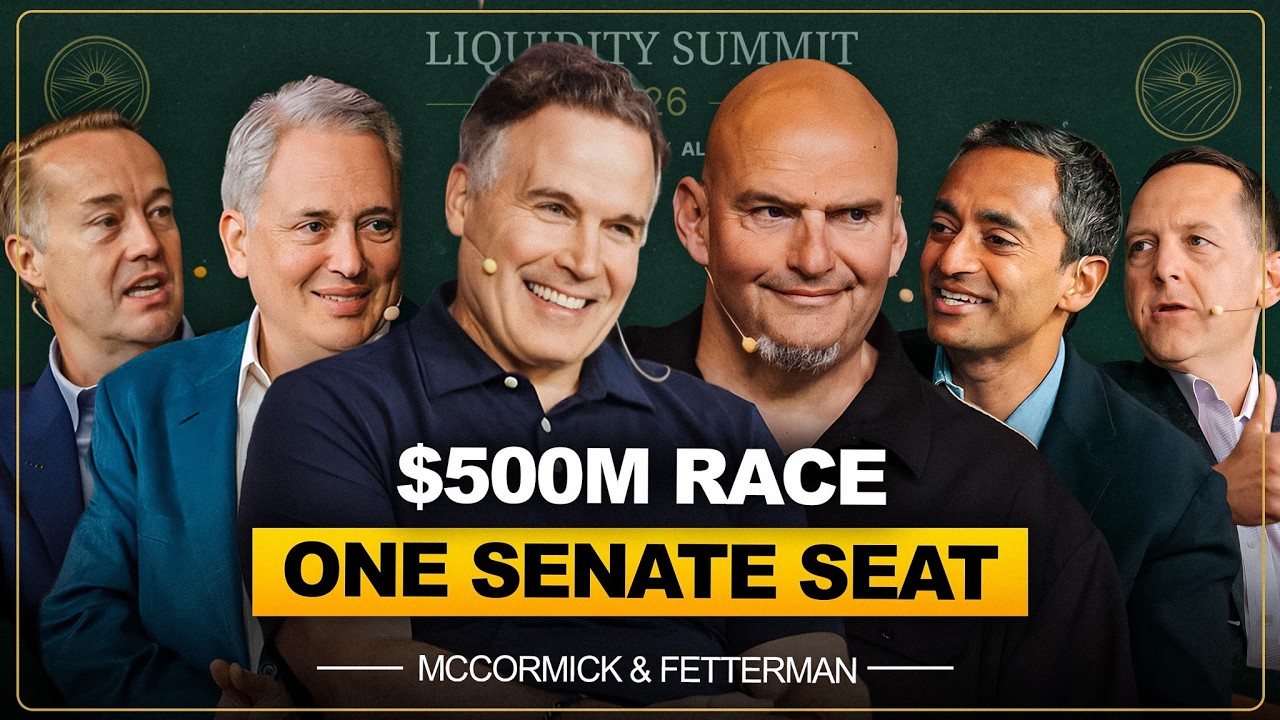
Senators John Fetterman and Dave McCormick: Bipartisanship, Money in DC, Datacenters, Graham Platner
Ask anything from this episode.
Save it, chat with it, and connect it to Claude or ChatGPT. Get cited answers from the actual content — and build your own knowledge base of every podcast and video you care about.
Get Started Free