Key Moments
Something Strange Happens When You Trust Quantum Mechanics
 Veritasium
Want to know something specific about what's covered?
We've already dissected every moment. Ask and we will deliver (with timestamps).
Key Moments
Quantum mechanics reveals particles explore all paths, not just one, explained by 'action' and interference.
Key Insights
Classical intuition suggests objects follow single trajectories, but quantum mechanics shows they explore all possible paths simultaneously.
The principle of least action, where systems follow paths minimizing a quantity called 'action' (related to kinetic and potential energy over time), governs these explorations.
Max Planck's solution to the blackbody radiation problem introduced quantization and Planck's constant (h), a quantum of action, marking the beginning of quantum mechanics.
Einstein extended quantization to light (photons), and Bohr applied it to atomic electron orbits, using quantized angular momentum (related to Planck's constant).
Louis de Broglie proposed wave-particle duality for matter, explaining Bohr's quantization condition as a consequence of electrons existing as standing waves in atoms.
Richard Feynman's path integral formulation suggests particles sum amplitudes of all possible paths, with constructive interference around the path of least action leading to observed classical behavior.
The demonstration with a diffraction grating and a laser showcases how interference patterns arise from light taking multiple paths, confirming quantum principles visually.
Understanding physics through the lens of action and Lagrangians provides a unified framework for classical and quantum mechanics, guiding the search for a theory of everything.
THE ILLUSION OF A SINGLE PATH
Our everyday experience leads us to believe that objects, like a thrown ball or a beam of light, follow a single, well-defined trajectory through space. However, quantum mechanics reveals a fundamentally different reality. Particles, including light, electrons, and protons, do not adhere to a sole path. Instead, they simultaneously explore every conceivable route between two points. This counter-intuitive concept challenges our classical understanding and hints at a deeper, more complex mechanism governing motion and interaction at the quantum level.
LEAST ACTION AND EARLY QUANTUM REVOLUTIONS
The idea that nature optimizes a quantity called 'action' dates back to Maupertuis and Hamilton, who defined it mathematically. This principle gained profound significance with the advent of quantum mechanics. Max Planck's resolution of the blackbody radiation problem, which famously predicted an 'ultraviolet catastrophe,' introduced the concept of energy quantization and Planck's constant (h), a fundamental quantum of action. This was a radical departure, suggesting that energy exchanges occur in discrete packets, not continuously.
EINSTEIN, BOHR, AND DE BROGLIE'S WAVE-PARTICLE DUALITY
Albert Einstein expanded on Planck's work, proposing that light itself is quantized into photons with energy proportional to frequency (E=hf). He used this to explain the photoelectric effect. Niels Bohr then applied quantization to explain atomic stability, suggesting electrons orbit the nucleus in discrete energy levels. Louis de Broglie later proposed that matter itself exhibits wave-like properties, stating that all particles have a wavelength inversely proportional to their momentum. This wave nature is crucial for understanding why quantized orbits are stable.
FEYNMAN'S PATH INTEGRAL FORMULATION
Richard Feynman's revolutionary 'path integral' formulation provides a powerful way to visualize and calculate quantum phenomena. It posits that a particle travels between two points by taking every possible path simultaneously. The probability of a particle arriving at a certain point is determined by summing the 'amplitudes' of waves associated with each path. These amplitudes have a 'phase' determined by the classical action along that path. Paths with dramatically different actions have phases that rapidly change, leading to destructive interference and cancellation.
THE CONSTRUCTIVE INTERFERENCE OF LEAST ACTION
The key to understanding why we observe single, predictable trajectories in the macroscopic world lies in constructive interference. Paths that are very close to the path of least action have similar actions, and thus their wave amplitudes add up constructively. This dominance of paths near the minimum action explains why classical mechanics, which is based on the principle of least action, appears so accurate for everyday objects. The minuscule value of Planck's constant ensures that only paths extremely close to the classical trajectory survive quantum cancellation.
VISUALIZING QUANTUM PATHS WITH INTERFERENCE
A compelling demonstration involves using a diffraction grating. When light passes through a grating with thousands of lines per millimeter, it splits into many paths. Initially, light reflects predictably at a single angle, as expected from classical physics. However, by strategically blocking parts of the grating, it's possible to reveal deviations from this single path. The experiment confirms that light indeed explores multiple paths, and interference patterns arise from the superposition of these paths, visually reinforcing Feynman's concept.
ACTION AS THE UNIFYING PRINCIPLE
The concept of action is fundamental to modern physics, serving as a unifying principle across different theories. Theoretical physicists often focus on formulating the correct 'Lagrangian' which defines the action for a given system. This approach underlies classical mechanics, relativity, and quantum field theory, offering a consistent mathematical framework. The ongoing search for a 'theory of everything' essentially involves finding a single Lagrangian that can correctly describe all the fundamental forces and particles in the universe.
Mentioned in This Episode
●Companies
●Studies Cited
●Concepts
●People Referenced
Action and Quantum Paths
Data extracted from this episode
| Object Type | Action (Relative to ħ) | Resulting Behavior |
|---|---|---|
| Everyday Objects (e.g., balls, planets) | Large | Only paths near the path of least action survive; behave like particles |
| Quantum Particles (e.g., electrons, photons) | Small | Wider spread of trajectories; exhibit wave-like behavior |
Common Questions
Yes, according to quantum mechanics and Feynman's path integral formulation, particles explore all possible paths between two points. The paths we observe are those where the wave amplitudes constructively interfere.
Topics
Mentioned in this video
More from Veritasium
View all 99 summaries 42 min
The Man Who Worked At Subway, Then Solved An "Impossible" Problem
 35 min
What Is Disrupting GPS Over Europe?
 30 min
How Does Google Maps Actually Work?
 22 min
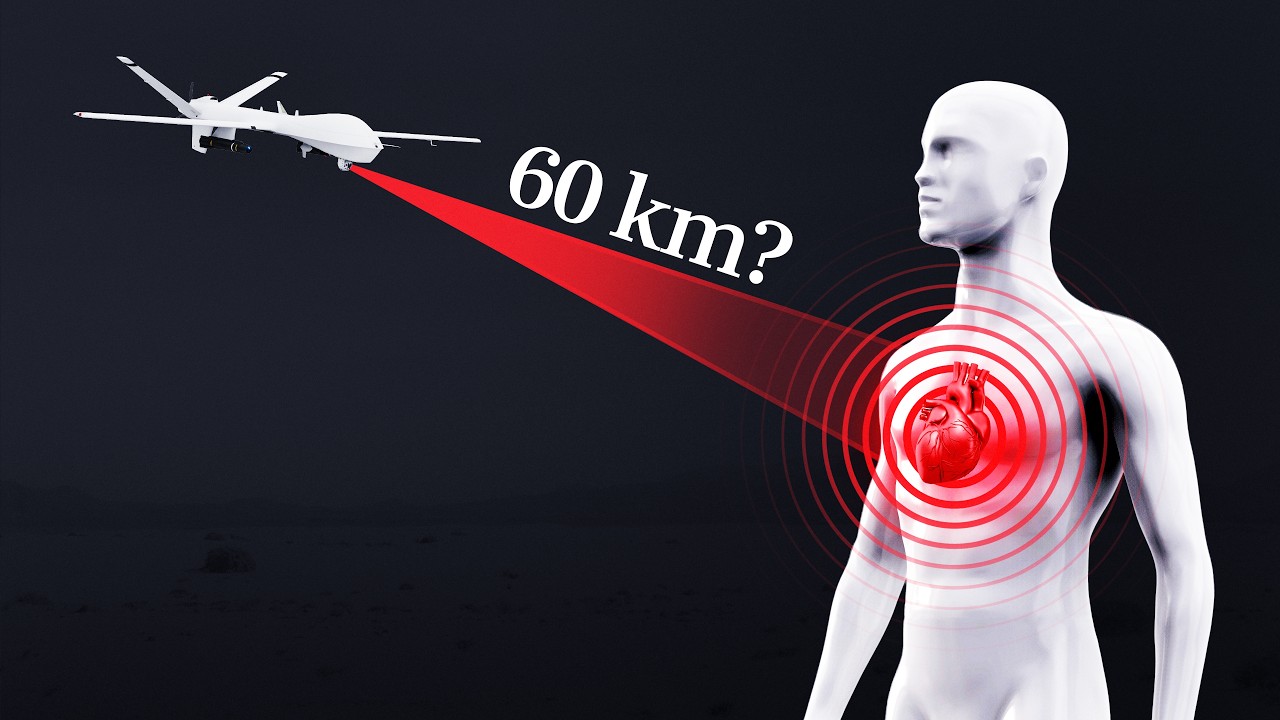
Can a quantum sensor detect your heartbeat from 60 km away?
Ask anything from this episode.
Save it, chat with it, and connect it to Claude or ChatGPT. Get cited answers from the actual content — and build your own knowledge base of every podcast and video you care about.
Get Started Free