Key Moments
Oxford Union Interview with Bridgewater CEO Nir Bar Dea
 Oxford Union
Key Moments
The world is undergoing a twin transformation: the end of globalization and the dawn of AI-driven superintelligence, leading to unprecedented wealth concentration and societal upheaval.
Key Insights
The 80-year era of globalization, characterized by increased wealth and interdependence, has ended, shifting towards a more nationalistic world prioritizing self-sufficiency.
The current technological revolution, driven by superintelligence, is comparable to the Industrial Revolution and is happening simultaneously with the shift away from globalization.
Wealth and power concentration are reaching levels not seen since before major global conflicts, with current trends indicating that 35% of global computing power could be in the hands of just two companies (OpenAI and Anthropic).
Bridgewater's 'radical transparency' culture is designed to accelerate learning by making thought processes and mistakes public, fostering a continuous iterative learning cycle.
The emergence of AI is transforming Bridgewater's operations from a meritocracy based on human intelligence to a 'biocratic meritocracy' where machine intelligence also generates ideas.
AI is still developing slower in 'gig' jobs with unclear objectives and in areas with very small datasets, presenting challenges and opportunities compared to human capabilities.
The end of the globalization era and the rise of nationalism
The world is currently experiencing a fundamental shift away from the 80-year era of globalization. This previous era fostered global cooperation, efficiency, and interdependence, leading to a significant increase in global wealth and lifting over a billion people out of poverty, particularly in Asia. However, this system, which involved offshoring production and creating complex, interdependent supply chains, has generated significant political backlash in Western countries. This has led to the rise of nationalistic governments that prioritize self-sufficiency and independence over global interdependence. This transition is already manifesting in trade tariffs, political instability, and international conflicts, marking a stark departure from the post-World War II global order.
The concurrent advent of a technological superintelligence revolution
Simultaneously with the geopolitical shift, the world is undergoing a technological revolution of a magnitude unseen since the Industrial Revolution. This revolution is characterized by the rapid development of superintelligence, with capabilities that are surpassing human intellect in various domains. The speaker draws parallels to chess, where machines first matched and then decisively surpassed human players. This is now occurring in fields like mathematics, life sciences, and programming. The implications of AI becoming 'smarter than us' are profound and unpredictable, creating immense disruption. The interaction between rising nationalism and the emergence of superintelligence is particularly concerning, as technological prowess could amplify global power imbalances and inequalities.
Historical parallels and escalating wealth concentration
Examining historical parallels, particularly the period before World War I, reveals a similar confluence of unprecedented peace, prosperity, and rapid change that ultimately collapsed. The Industrial Revolution also led to immense wealth creation, but this wealth became highly concentrated, causing disparities between individuals and nations, fueling colonialism, and contributing to internal conflicts. Bridgewater believes that the current productivity boom, driven by both globalization and AI, is creating wealth and power concentration comparable to those pre-conflict eras. Specific data points highlight this alarming trend: 35-37% of US market capitalization is held by just 10 companies, and 60% of US wealth is concentrated among billionaires. Furthermore, it's projected that 35% of global computing power could soon be controlled by only two AI companies, OpenAI and Anthropic, raising concerns about the consolidation of global intelligence.
The challenge of leadership in an era of unprecedented change
The speaker raises a critical concern about who will guide humanity through this period of immense global and technological transformation. Unlike previous generations, such as those who established the post-WWII global order (Bretton Woods, UN) after experiencing devastating conflicts and economic crises, the current generation has not faced comparable existential challenges. This lack of shared adversity raises questions about our collective preparedness and wisdom to navigate the complex decisions ahead. The speaker emphasizes that the future will not resemble the past and that understanding cause-and-effect relationships, a core tenet of Bridgewater's philosophy, is crucial for adaptation.
Bridgewater's mission: Understanding the world and seeking truth
Bridgewater's core mission is to understand how the world works by deeply investigating cause-and-effect relationships. In an era where truth is increasingly scarce and societal echo chambers amplify polarization, Bridgewater sees a profound purpose in its pursuit of understanding. As an 'unbiased asset manager,' capable of betting on both rising and falling markets, the firm is uniquely positioned to focus solely on accurately understanding the world, rather than being driven by specific investment biases. This commitment translates into advising governments and sovereign wealth funds globally on how to navigate these turbulent times, offering a 'map of reality' based on factual understanding.
Radical transparency as a catalyst for learning and adaptation
Bridgewater's culture of 'radical transparency' is central to its philosophy of accelerating learning. This practice involves making thought processes, decision-making, and even mistakes public and accessible to all employees. The goal is not to focus on outcomes alone but on the underlying thinking processes, allowing for continuous learning and improvement. By openly sharing feedback, recording conversations, and holding individuals accountable for their decisions, the firm aims to foster a 'recursive learning loop.' This painful yet powerful process enables individuals and the organization as a whole to learn from each other's experiences, leading to more robust and well-considered strategies, especially crucial in navigating complex, uncertain futures.
The evolving nature of talent and the 'biocratic meritocracy'
The recruitment at Bridgewater seeks individuals with a deep passion for learning, a willingness to embrace being wrong, and a commitment to lifelong development. In the context of AI, Bridgewater is evolving from a human-centric meritocracy to a 'biocratic meritocracy.' This involves integrating machine intelligence alongside human intelligence in the idea generation and decision-making processes. By building separate AI factories that mirror their human intelligence processes, Bridgewater aims to harness the complementary strengths of both. While human and AI systems are performing well, they often present different perspectives on the world, highlighting that each possesses a unique piece of the puzzle. The firm recognizes that AI is advancing exponentially, especially in generating new intelligence and ideas, necessitating continuous adaptation in talent acquisition and organizational structure to remain at the forefront.
AI's profound impact on Bridgewater's operations and investment strategies
AI is fundamentally altering how Bridgewater operates, with the firm stating it represents 'half of everything'—half the drivers of asset prices, policy decisions, and violent events. The integration of AI has transformed their meritocratic system into a 'biocratic meritocracy.' Ideas now emerge from both human and machine intelligence, which are then synthesized and tested in markets. A significant strategic decision in 2022 involved building a dedicated AI factory, separate from their human intelligence operations, to rigorously map and trade the world. The astonishing result is that both human and AI systems are performing exceptionally well, though they offer distinct worldviews. As AI's capabilities expand exponentially, Bridgewater anticipates that organizations failing to embrace this biocratic approach and the accelerating wave of intelligence will be left behind. This presents both exciting opportunities and daunting challenges for the future.
Mentioned in This Episode
●Companies
●Organizations
●People Referenced
Common Questions
Bridgewater's core philosophy is to understand how the world works by rigorously seeking truth and understanding cause-and-effect relationships. They believe that by deeply comprehending reality, one can better navigate future challenges and opportunities.
Topics
Mentioned in this video
Mentioned as a location where manufacturing operations moved to from the US due to lower costs, contributing to global supply chains. Also mentioned as a country receiving Bridgewater's consulting services.
Mentioned as a location where manufacturing operations moved to from the US due to lower costs, contributing to global supply chains.
Mentioned as a location where political problems arise from the shift away from globalization and towards nationalism. Bridgewater also provides consulting to its policymakers.
Mentioned as a country where Bridgewater provides consulting services to policymakers.
One of the two companies expected to hold 35% of the world's computing power, and subsequently, potentially 35% of the world's intelligence. Also mentioned as a player in AI development.
Mentioned as the largest company ever in terms of market capitalization, highlighting the concentration of power in a few tech companies.
One of the two companies expected to hold 35% of the world's computing power, and subsequently, potentially 35% of the world's intelligence. Also mentioned as a player in AI development.
Part of the global system established after WWII by individuals who had experienced significant hardship, aimed at creating a better future.
Part of the global system established after WWII by individuals who had experienced significant hardship, aimed at creating a better future.
More from OxfordUnion
View all 109 summaries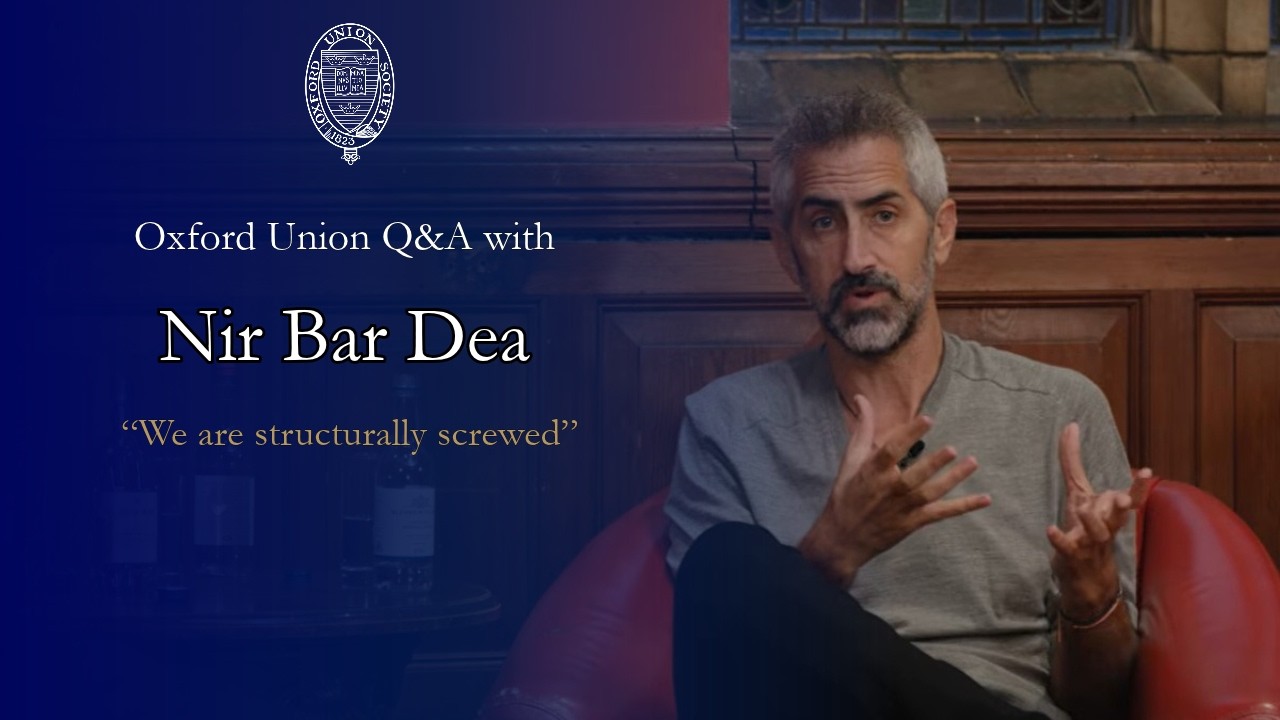 33 min
Oxford Union Q&A with Bridgewater CEO Nir Bar Dea
 25 min
Oxford Union Q&A with Alan Dershowitz
 53 min
Oxford Union Interview with Alan Dershowitz
 21 min
Susan Abulhawa | This House Believes Israel is an Apartheid State Responsible for Genocide | 7/8
Ask anything from this episode.
Save it, chat with it, and connect it to Claude or ChatGPT. Get cited answers from the actual content — and build your own knowledge base of every podcast and video you care about.
Get Started Free