Key Moments
MicroBooNE | Studying the elusive neutrino
 Fermilab
Want to know something specific about what's covered?
We've already dissected every moment. Ask and we will deliver (with timestamps).
Key Moments
Neutrino footprints imaged in liquid argon; MicroBooNE informs future detectors.
Key Insights
Neutrinos are extremely abundant but interact so rarely that they are called ghost particles.
MicroBooNE uses a liquid argon time projection chamber (LArTPC) to capture detailed, image-like records of neutrino interactions.
The detector acts like a 3D camera, producing visible footprints (tracks) of particles after a neutrino collision.
Celebrating 10 years, MicroBooNE has taught us much about installation, operation, data handling, and physics measurements.
Findings from MicroBooNE inform the design and expectations of SBND, ICARUS, and the DUNE program.
Even after data taking paused, the collaboration continues with test analyses to refine physics models and interpretations.
NEUTRINOS: GHOST PARTICLES AND THE QUEST TO OBSERVE
Neutrinos are among the most abundant yet least understood particles in the universe. They permeate every region of space, including the matter around us, yet they interact so rarely that trillions pass through us each second without a trace. This elusive nature makes studying them extraordinarily challenging and drives the need for large, sensitive detectors. MicroBooNE was designed to tackle this challenge by observing neutrinos produced in a beam and capturing the fleeting interactions they cause within a dense target. By focusing on the details of these events, researchers aim to piece together a precise picture of neutrino properties, interaction rates, and how neutrinos transform as they pass through matter. The effort is part of a broader quest to understand fundamental forces and the role of neutrinos in the cosmos, including their contributions to oscillation phenomena and nuclear effects inside detectors.
LIQUID ARGON TECHNOLOGY: A 3D CAMERA FOR NEUTRINO INTERACTIONS
MicroBooNE’s core technology is a liquid argon time projection chamber (LArTPC), which acts like a high-resolution, three-dimensional camera for particle interactions. When a neutrino collides with an argon nucleus, it leaves ionization trails and light signals inside the liquid. An electric field drifts the ionization electrons toward wire planes, where they are read out to reconstruct the path and energy of the outgoing particles. The resulting images reveal the topology of the interaction in exquisite detail, enabling researchers to distinguish between interaction channels, identify the products of the collision, and study how the nuclear environment modifies the final state. This imaging capability is essential for separating signal from background and for performing precise cross-section measurements that feed into theoretical models.
A DECADE OF DISCOVERY: INSTALLATION, OPERATION, AND PHYSICS MEASUREMENTS
As MicroBooNE marks its 10th anniversary, the collaboration reflects on a journey that began with installing and commissioning the detector, moving through steady operations, and culminating in a broad program of physics measurements. The effort spans not only hardware and software development but also the data analysis techniques that turn raw signals into physics results. The experience has yielded invaluable lessons about detector stability, calibration, and event reconstruction. These insights have helped optimize current measurements and set benchmarks for how future detectors should operate, including how to handle data, manage systematics, and validate simulations against real data.
LINKS TO THE FUTURE: INFORMING SBND, ICARUS, AND DUNE
MicroBooNE does not exist in isolation; its findings directly inform the next generation of detectors in the same program. The results and experiences from MicroBooNE—ranging from calibration procedures to reconstruction algorithms and understanding of nuclear effects—feed into SBND (Short-Baseline Near Detector), ICARUS, and the larger DUNE project. By validating modeling approaches and measurement techniques, MicroBooNE helps set expectations for detector performance, data quality, and physics reach across the near and far detectors. The collaboration’s cumulative knowledge accelerates progress toward precise neutrino measurements and robust tests of fundamental theories.
PHYSICS IMPACT AND CONTINUED TESTS: REFINING MODELS AND INTERPRETATIONS
Even after data-taking for certain runs has paused, the physics program continues through ongoing testing and analysis. Researchers compare MicroBooNE data with various theoretical models to understand interaction dynamics, nuclear effects, and possible anomalies. This ongoing work includes refining cross-section calculations, validating simulation tools, and exploring how different interaction channels contribute to observed signals. The aim is to tighten constraints on models, reduce systematic uncertainties, and provide a solid, data-driven foundation for interpreting results from DUNE and related experiments. The continual probing of theory against real data keeps the field moving forward.
Mentioned in This Episode
●Products
●Software & Apps
●Companies
Common Questions
MicroBooNE is a neutrino detector that uses a liquid-argon time projection chamber to image neutrino interactions. The video describes it as a '3D giant camera' that captures footprints from interactions, allowing scientists to see what happened inside the detector.
Topics
Mentioned in this video
Short-Baseline Near Detector; part of the DUNE program, informed by MicroBooNE data.
A neutrino detector using a liquid-argon time projection chamber; described as a 3D camera that captures footprints from neutrino interactions to reveal what happened inside.
ICARUS detectors; part of the DUNE program, mentioned as being informed by MicroBooNE data.
More from Fermilab
View all 57 summaries 8 min
8 minIs dark matter hiding in the neutrino fog? | Even Bananas
 2 min
2 minThe Dark Energy Survey | Investigating how the universe expands
 79 min
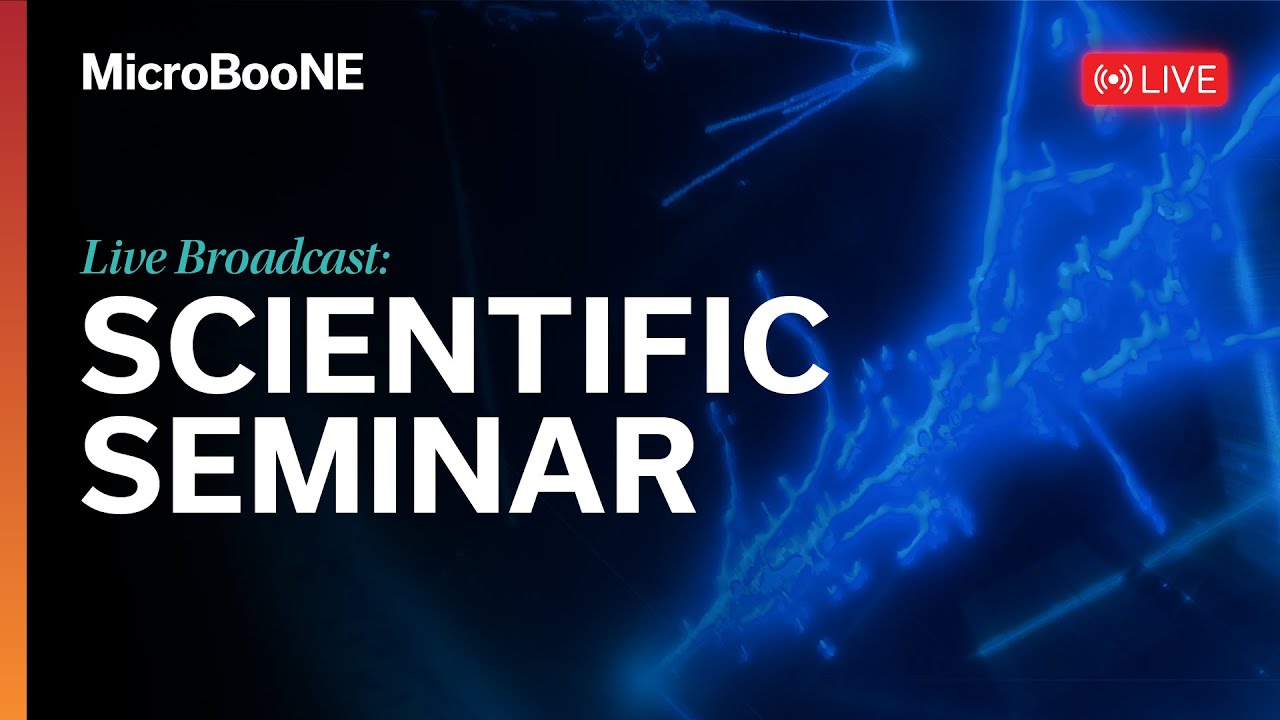
Scientific Seminar: MicroBooNE finds no evidence for a single sterile neutrino
 8 min
8 minICARUS: The search for new physics
Ask anything from this episode.
Save it, chat with it, and connect it to Claude or ChatGPT. Get cited answers from the actual content — and build your own knowledge base of every podcast and video you care about.
Get Started Free