Key Moments
Ben Shapiro talks about Israel vs Hamas and why he would never support Biden over Trump
 Oxford Union
Key Moments
Ben Shapiro argues that while civilian casualties in war are tragic, intentionally targeting civilians is morally distinct from attempting to kill terrorists who hide among them, a distinction he believes is being deliberately obscured.
Key Insights
The debate centers on the moral distinction between intentional targeting of civilians versus civilian casualties as a byproduct of targeting combatants, with Shapiro asserting a clear difference that others are obscuring.
Shapiro claims that Hamas initiated the current conflict by killing 1,500 Israelis and taking 233 hostages, while opponents highlight pre-October 7th Palestinian deaths in the West Bank and the issue of Palestinian prisoners.
The discussion touches on the historical context of Palestine and Jordan, with differing views on whether Jordan was historically part of Palestine and the nature of the British Mandate.
Shapiro argues that a consistent rejection of peace deals and the existence of a Jewish state by Arab leadership is the fundamental obstacle to a resolution.
Regarding the West's values, Shapiro believes a decline in traditional Judeo-Christian foundations has led to moral relativism and a weakened ability to assert its identity.
Shapiro suggests that while Donald Trump may have peculiar desires, the US constitutional system is durable, and Joe Biden has also utilized executive power in "exorbitant" ways, making the choice between them complex.
The moral distinction in targeting civilians
Ben Shapiro asserts that a fundamental moral difference exists between intentionally murdering civilians and attempting to kill terrorists who deliberately hide among civilian populations, thereby causing accidental civilian casualties. He argues that this distinction is being deliberately obscured by those who equate the two scenarios. Shapiro uses the analogy of World War II, where 2 million German civilians died during the Blitz while 70,000 British civilians died, suggesting that the scale of civilian deaths does not inherently render the war unjust if the intent was not to target civilians. He emphasizes that Hamas's actions of deliberately murdering entire families and hiding among civilians are fundamentally different from Israel's efforts to target terrorists, even when civilian deaths occur. This core argument is that while war is brutal, the intent behind the actions is paramount in moral evaluation. The implication is that failing to recognize this distinction leads to a flawed understanding of the conflict and a dangerous erosion of moral clarity. Therefore, Shapiro posits that any position which fails to acknowledge this moral differentiation is inherently flawed and dangerous for the future, not just for Israel but for any society seeking to defend itself against terrorism.
Historical context and peace proposals
A significant point of contention revolves around the history of the Israeli-Palestinian conflict and various peace proposals. Shapiro contends that Arab leadership has consistently rejected peace deals, including the UN Partition Plan of 1947, the Oslo Accords, the Yasser peace plan in 2000, and Ehud Olmert's offer in 2008. He attributes this rejection to a fundamental refusal to accept the existence of a Jewish state in the region. Conversely, critics argue that these proposals often involved the expulsion of Arab populations and were presented under colonial authority, making them unacceptable from a Palestinian perspective. The nature of the British Mandate for Palestine and the separation of Transjordan are also debated, with differing interpretations of historical boundaries and claims. Shapiro maintains that as long as the core issue of accepting a Jewish state remains unresolved, no lasting peace can be achieved, framing the rejections as a persistent obstacle to a two-state solution.
Hamas's role and the justification for action
Shapiro places the initiation of the current conflict squarely on Hamas, citing their attack on October 7th, which resulted in the deaths of 1,500 Israelis and the taking of 233 hostages. He argues that Hamas has oppressed its own people, stealing billions of dollars while its leaders live in luxury abroad. Consequently, he sees the obliteration of Hamas as a necessary act of self-defense and compassion, not only for Israelis but also for Palestinians suffering under Hamas rule. Opponents, however, point to the significant number of Palestinian civilian casualties, including children, both before and during the current conflict, questioning the justification for actions that result in such high death tolls, particularly in densely populated areas like Gaza. They also raise concerns about Palestinian prisoners held by Israel without charge. Shapiro counters that while civilian casualties are a tragic cost of war, they are distinct from intentional targeting, and that terrorist groups deliberately place civilians in harm's way, negating any claim to immunity.
The erosion of Western values
Shapiro expresses concern that the West is losing its sense of identity and core values, leading to moral relativism. He attributes this decline partly to the secularization of traditionally Judeo-Christian foundations, which he believes provided a common moral code essential for societal cohesion and the promotion of liberalism, freedom, and religious worship. He views this as a 'cut flower syndrome,' where values, detached from their roots, eventually wither. This, in his opinion, makes the West vulnerable to being overtaken by alternative value systems. He does not see this collapse as inevitable and anticipates a backlash against what he calls the 'insane self-blinding' of the West, which he believes is based on a false assumption that all people think and operate with the same incentive structures. He argues that Western values, despite historical mistakes, are superior to other available value systems.
Political choices and threats to democracy
Discussing the American political landscape, Shapiro acknowledges that politics is often a negative referendum on candidates rather than a positive endorsement. He notes the durability of the US constitutional system, suggesting that January 6th was more a threat to order than to democracy itself, as institutions ultimately held. He perceives threats to democracy from both Donald Trump and Joe Biden, albeit different kinds. While Trump's actions and rhetoric may be more obvious threats, Biden has also, in Shapiro's view, used executive power in "exorbitant" ways. He states a preference for candidates who prioritize rationality but finds both major parties' likely nominees flawed. Shapiro believes a strong third party is unlikely to succeed in the US due to the entrenched two-party system, suggesting it's easier for figures to take over existing parties from within, as Trump did with the Republican party and Bernie Sanders did within the Democratic party.
The debate on abortion and the sanctity of life
Shapiro's pro-life stance is challenged by the practical implications for low-income women, who may resort to unsafe abortions if legal options are restricted. He acknowledges the reality of abortions but prioritizes the protection of the unborn child, arguing that any law will have downsides, and the goal is to prohibit abortion and preserve lives. He rejects the idea that a woman's safety in violating the law should be the top priority, stating his preference for a law that affects everyone equally, rich or poor, and ideally, no one having abortions at all. He believes that making abortion more difficult to obtain leads to fewer abortions, which is the purpose of prohibition.
Defending Palestinian lives and moral equivalence
Shapiro addresses the accusation that he doesn't defend Palestinian civilian lives with the same fervor as Israeli civilian lives. He clarifies that while he believes all lives matter, his disagreement with the Black Lives Matter movement stems from not accepting its premise that Black people are uniquely targeted by law enforcement. Regarding the Israel-Hamas conflict, he reiterates that he values Palestinian lives equally to Jewish lives, but differentiates between targeting terrorists and intentionally harming civilians. He expresses a strong belief in clear moral differentiation and asks those who conflate the intentional targeting of terrorists with Hamas's deliberate targeting of civilians to examine their own reasoning.
The path to defeating Hamas
Shapiro admits he is not privy to the specific military plans for defeating Hamas. However, he stresses that any strategy that does not result in Hamas being "off the board" is extremely dangerous for Israel's future. He believes Hamas has proven far more dangerous than initially assessed and that a perception of Israeli military weakness could embolden other groups. The ideal scenario, in his view, is for Hamas to surrender, and he questions why anyone, even for the sake of Palestinians, would not want Hamas removed. He acknowledges that surrender is unlikely, making the deposition of Hamas as quickly and easily as possible a shared interest. He foresees a difficult and costly campaign, with significant Israeli soldier casualties due to urban warfare and the extensive tunnel system Hamas has built.
Mentioned in This Episode
●Companies
●Organizations
●Concepts
●People Referenced
Common Questions
Ben Shapiro's primary argument is that Hamas is a terrorist organization that initiated the current war by attacking Israel and taking hostages. He believes its overthrow is necessary for Israel's security.
Topics
Mentioned in this video
Former President of the United States. Discussed as a potential candidate in the 2024 election and a 'threat' to American democracy, with contrasting views on the severity of the threat.
The first Prime Minister of Israel. His diaries are cited regarding the partition plan and its temporary nature.
Governor of Florida and a Republican presidential primary candidate. The speaker states they would vote for him in the primaries.
Members of the Hamas organization who carried out attacks. Their actions are described as deliberate murder, including the burning of babies.
Current President of the United States. His presidency and actions are contrasted with Donald Trump's, with differing views on which poses a greater threat to democracy.
A U.S. Senator and former presidential candidate. Cited as an example of a politician successfully shifting the Democratic Party further left.
The current Prime Minister of Israel. Mentioned in the context of military strategy and the goal of defeating Hamas.
A social and political movement advocating for the rights and liberation of Black people. The speaker critiques its premise regarding law enforcement targeting.
A Palestinian Islamist fundamentalist organization that has been designated as a terrorist group by several countries. The speaker argues for its overthrow and views it as the primary threat.
The Israel Defense Forces, the military arm of Israel. Their operations in the West Bank and Gaza are discussed in relation to civilian casualties and counter-terrorism efforts.
A Palestinian Islamic fundamentalist militant group. Mentioned as another significant terror group operating in the West Bank.
The Occupational Safety and Health Administration. Mentioned as an example of President Biden using executive branch power in 'exorbitant ways'.
International treaties that contain important provisions for the treatment of war victims. Their violation is discussed in the context of Hamas hiding behind civilians.
A set of agreements signed between Israel and the Palestine Liberation Organization (PLO) in the 1990s aiming for peace. The speaker claims they were rejected by Arabs.
The ethical and moral principles derived from Judaism and Christianity, considered a foundation of Western civilization.
A slogan often used in response to Black Lives Matter, asserting that all human lives are equally valuable. The speaker states they believe this principle.
More from OxfordUnion
View all 101 summaries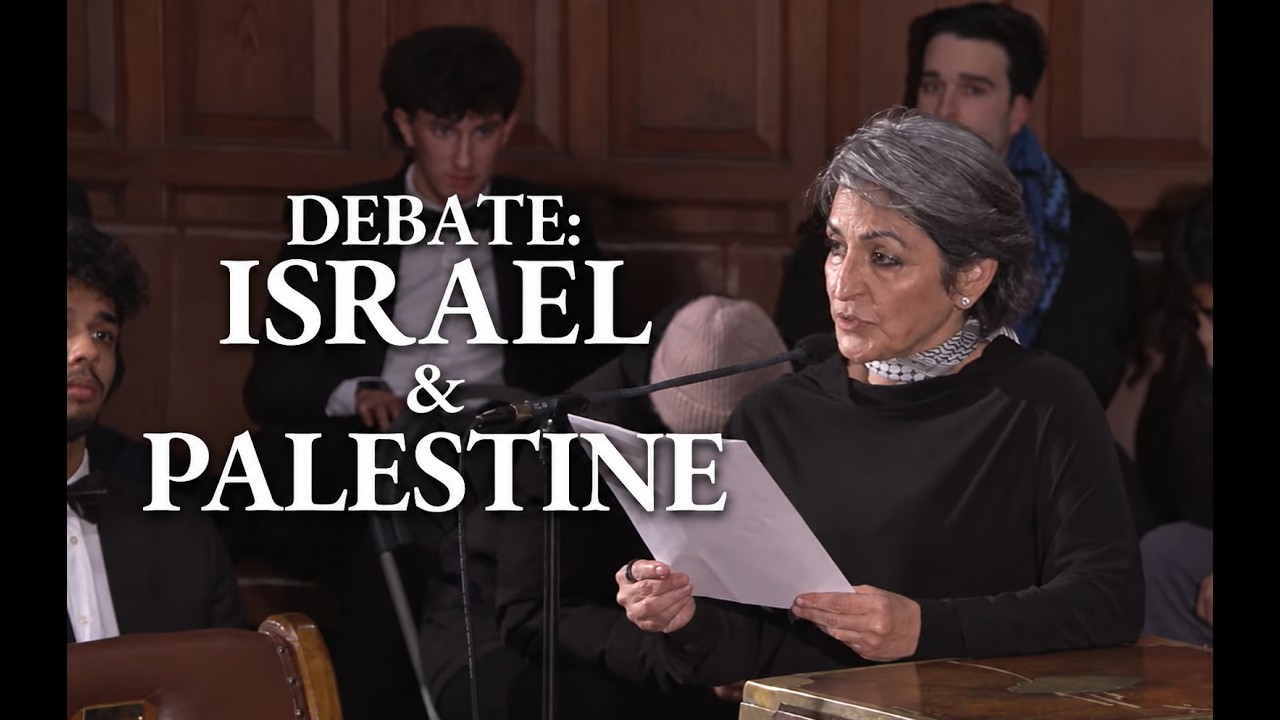 21 min
Susan Abulhawa | This House Believes Israel is an Apartheid State Responsible for Genocide | 7/8
 154 min
THB Israel Never Truly Wanted Peace with Palestine - Full Debate
 110 min
THB Trump has Betrayed Conservatism - Full Debate
 80 min
This House Hopes that Hell Exists - Full Debate
Ask anything from this episode.
Save it, chat with it, and connect it to Claude or ChatGPT. Get cited answers from the actual content — and build your own knowledge base of every podcast and video you care about.
Get Started Free