Key Moments
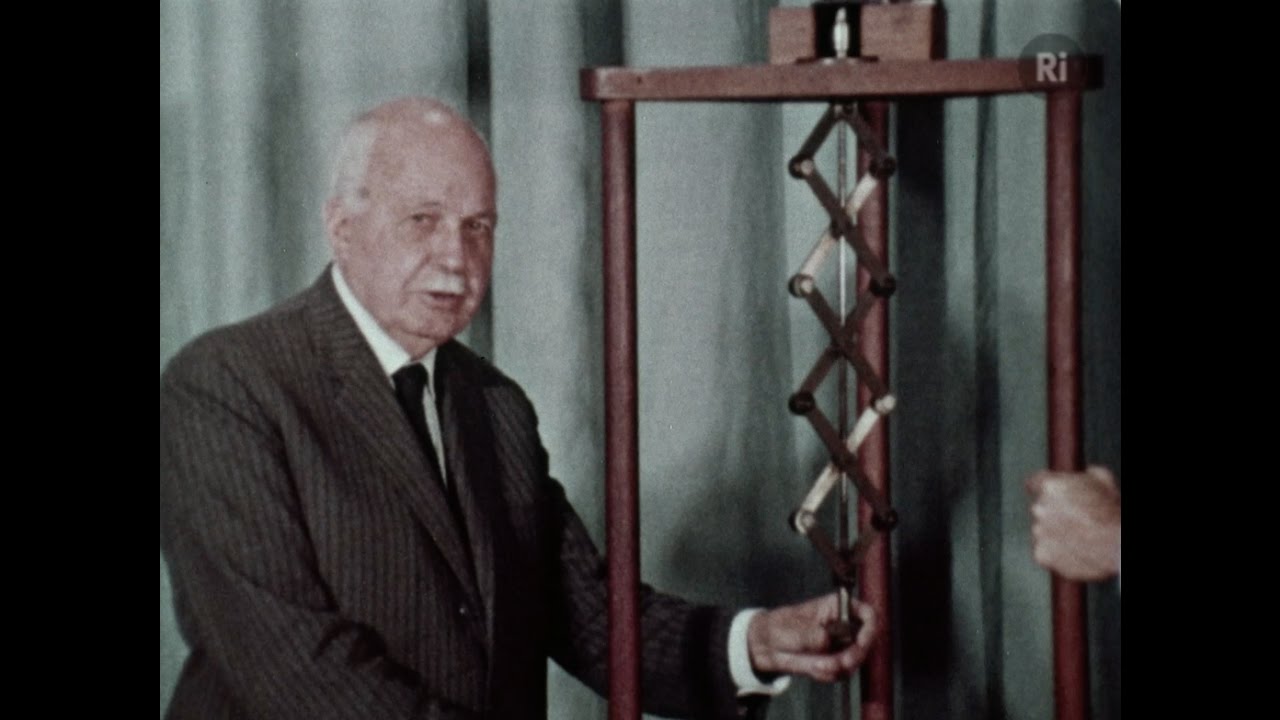
Young and the Wave Theory of Light - with Sir Lawrence Bragg
 Royal Institution
Want to know something specific about what's covered?
We've already dissected every moment. Ask and we will deliver (with timestamps).
Key Moments
Young's interference experiments prove light behaves as waves, explaining fringes and sharp shadows.
Key Insights
There was a historic debate in the 1700s about light being waves (Huygens) or particles (Newton).
Thomas Young's pinhole and later double-slit experiments demonstrated interference, supporting the wave theory.
Interference patterns (bright and dark fringes) arise from the superposition of two light waves, not from particle collisions.
Sharp shadows with light imply a very small wavelength relative to obstacle size; long wavelengths bend around edges more.
Diffraction and edge-bending show light can bend around obstacles, further illustrating its wave nature.
Young's work at the Royal Institution helped establish the wave theory as a foundational concept in optics.
HISTORICAL CONTEXT: LIGHT AS WAVES OR PARTICLES
In the 1700s, optical science was split between two competing pictures of light: a wave theory championed by Huygens and a particle view supported, though tentatively, by Newton. The speaker emphasizes Newton's cautious stance and notes that his followers leaned more heavily on the particle concept. The era’s tensions set the stage for experiments that could distinguish waves from bullets. The narrative then pivots to Thomas Young, a man of diverse pursuits, whose work would tilt the balance decisively toward the wave interpretation by demonstrating interference.
YOUNG'S PINHOLE EXPERIMENT AND THE INTERFERENCE PRINCIPLE
Young’s pinhole experiment introduced the essential idea of interference: light from two close pinholes spreads and overlaps, producing alternating bright and dark regions on a screen. When crests align with crests (or troughs with troughs), light intensifies; when a crest meets a trough, light cancels. This pattern, visible as fringes, could only be explained if light consisted of waves capable of superposition. The demonstration, coupled with his drawings, provided a clear, interpretable picture of how wavefronts from two sources interact to create a structured intensity pattern.
EXTENDING TO SLITS: OBSERVING BRIGHT AND DARK FRINGES
To gather more light and sharpen the demonstration, Young shifted from pinholes to slits and used an arc lamp as a source. The setup produced well-defined fringes on a distant screen, confirming that multiple coherent sources (slits) generate a predictable fringe pattern. By manipulating which slit is open, observers could see the formation and alteration of fringes, reinforcing the idea that light behaves as a wave with a definite wavelength capable of producing constructive and destructive interference.
SHARP SHADOWS AND THE WAVELENGTH ARGUMENT
A key historical puzzle was why light, if it travels as waves, can produce such sharp shadows. The speaker explains that the sharpness arises because light’s wavelength is extremely small relative to typical obstacle sizes. Through demonstrations with short and long wavelengths, the audience observes that short waves yield crisp shadows, whereas long waves bend and smear around edges. This sharp-shadow phenomenon became a crucial empirical touchstone supporting the wave picture and clarifying why some skeptics doubted wave behavior at first.
DIFFRACTION, EDGE BENDING, AND HEALING OF WAVES
The lecture moves from broad fringes to localized effects, showing diffraction around edges and through slits. By placing sharp edges or needles in the path, light behaves as if it bends around obstacles and fills in shadows in characteristic patterns. The distance and geometry control the diffraction fringes, illustrating how wavefronts adapt to obstacles. Real-world cues, like observing street lamps through a window edge, reinforce the idea that light’s wave nature manifests in both interference and diffraction phenomena.
THE LEGACY: YOUNG, THE ROYAL INSTITUTION, AND THE WAVE THEORY'S RISE
The talk culminates by highlighting Young’s broader stature—professor at the Royal Institution and a pioneer who reshaped our understanding of light. His experiments did not merely prove a point; they launched a new chapter in optics, explaining why shadows can be so sharp and why fringes form in predictable patterns. The lecturer emphasizes that Young’s work helped cement the wave theory of light as a foundational framework, reshaping subsequent research and the broader scientific narrative about light and vision.
Mentioned in This Episode
●Tools
●Concepts
●People Referenced
Fringe Interference Quick Guide
Practical takeaways from this episode
Do This
Avoid This
Common Questions
Young's interference demonstration using two slits is described as a defining proof of wave-like light behavior, with the key ideas presented around 1800. The video covers the setup and interpretation of the fringes to support the wave theory.
Topics
Mentioned in this video
British physician and scientist whose double-slit experiment provided strong evidence for the wave theory of light.
Historian/scientist credited in the talk with explaining how sharp shadows arise in diffraction.
Dutch physicist who advocated the wave theory of light; discussed early wave pictures of reflection and refraction.
More from Ri Archives
View all 10 summaries 25 min
Crystals - Alan Holden 1958
 25 min
Prelude to Power
 16 min
Magnetism #1 - with Sir Lawrence Bragg
 21 min
Plastics and Rubbers - Properties of Matter #4
Ask anything from this episode.
Save it, chat with it, and connect it to Claude or ChatGPT. Get cited answers from the actual content — and build your own knowledge base of every podcast and video you care about.
Get Started Free