Key Moments
Why Google failed to make GPT-3 -- with David Luan of Adept
 Latent Space Podcast
Key Moments
David Luan discusses AI agents, the evolution of AI research from OpenAI to Google, and Adept's focus on reliable enterprise AI agents.
Key Insights
AI agents are a natural evolution towards AGI, defined as AI capable of performing any human computer task.
Google's historical challenges in scaling LLMs were due to internal resource allocation issues (Brain Credit Marketplace).
Adept prioritizes reliability in AI agents, focusing on enterprise solutions over a developer-first API model.
The future of AI progress will be driven by the co-design of products, user feedback, and technology.
Multimodal models are becoming the default foundation model, with a shift towards training on knowledge work data (charts, tables, UIs) rather than just natural images.
Adept's strategy as an augmentation company fosters a data flywheel by incorporating human oversight and feedback.
FROM OPENAI TO GOOGLE BRAIN: A CAREER IN AI LEADERSHIP
David Luan recounts his early career, starting with Dextro, an AI company acquired by ExxonMobil. He then joined OpenAI as an early hire, leading engineering and influencing its technical direction towards large-scale bets rather than solely novel research. Later, at Google, he co-led Google Brain and led the company's LLM efforts, gaining insights into the different eras of AI research and the importance of resource allocation for massive projects.
THE SHIFT IN AI RESEARCH: FROM RESEARCH PAPERS TO PRODUCT CO-DESIGN
Luan categorizes AI research into distinct eras, marking 2017 as a pivotal year with the advent of Transformers. He observes that recent AI progress, particularly in the next few years, will be driven by the deep co-design and co-evolution of products and users. This feedback loop, combined with technological advancements, is crucial for labs and companies aiming for success, influencing his decision to found Adept.
AGENTS AS THE FUTURE: DEFINING AND BUILDING AI CAPABILITY
Luan views AI agents as the correct long-term direction for AGI, defining it not by human replacement but by AI's ability to outperform humans in economically valuable tasks. He emphasizes a more tractable definition: an AI model that can do anything a human can do on a computer. He also highlights the field's rediscovery of RL lessons, arguing that LLMs act as a powerful 'behavioral cloner' of human knowledge, paving the way for universal models.
THE CHALLENGE OF SCALING AT GOOGLE VERSUS OPENAI'S STRATEGY
Luan explains Google's internal challenges in scaling LLMs, particularly the 'Brain Credit Marketplace,' which hindered critical mass acquisition for large projects. In contrast, OpenAI's focused strategy on making 'giant swings and bets' and executing them at all costs proved more effective. This focus on scientific outcomes, regardless of novelty, became dominant, highlighting the importance of resource allocation and strategic direction.
ADEPT'S MISSION: RELIABLE AI AGENTS FOR ENTERPRISE WORKFLOWS
Adept aims to build AI agents that assist humans with any task on a computer, translating natural language goals into actionable steps across various software tools. Unlike many in the space, Adept is an 'enterprise company,' focusing on out-of-the-box solutions for complex workflows rather than selling APIs or open-source models. Reliability is paramount, distinguishing them from other agent demos that function less consistently.
PRIORITIZING RELIABILITY AND AUGMENTATION OVER AUTOMATION
Adept's commitment to 'nines of reliability' has led them down a different technological path, prioritizing dependability over speed or breadth in early stages. They see agents as augmenting human capabilities rather than fully replacing them, which creates a data flywheel. This approach allows them to learn from skilled humans and continuously improve AI by tackling tasks too complex for current models alone.
THE EVOLUTION OF MULTIMODAL MODELS AND KNOWLEDGE WORK
Luan discusses the development of multimodal models, emphasizing a shift from training on natural images to data relevant to knowledge work, such as charts, graphs, and UIs. This focus is crucial for agents operating in enterprise environments. Adept has invested heavily in building fast, multimodal models adept at understanding screens and dense OCR, forming the foundation for their reliable agent technology.
INTERACTION LAYERS: FROM GUIS TO GENERATIVE AGENT INTERFACES
The interaction layer for AI agents is evolving. Luan draws an analogy to the transition from command-line interfaces to GUIs. He posits that agents will control current GUIs and APIs, but future interfaces may become generative, offering a new standard interaction layer. This shift means software will increasingly be controlled by agents, with humans potentially interfacing less directly with underlying applications.
NAVIGATING THE TRADE-OFFS: RELIABILITY, GENERALITY, AND COST
Luan acknowledges the inherent trade-off between reliability and generality in AI development, especially at the frontier. Adept addresses this by framing agent problems to benefit from data collection, ensuring each use case contributes to broader learning rather than being overly prescriptive. This approach helps manage costs and speed while maintaining a high standard of performance, distinguishing them from companies solely focused on fine-tuning base models.
ADEPT'S ADVANTAGE: AGENT STACK OVER BASE MODELS
Adept believes its advantage lies not just in base models but in building a comprehensive agent stack through vertical integration. This allows for efficient allocation of resources, focusing on agents specifically trained for knowledge work tasks rather than general-purpose foundation models. They see pure-play foundation model companies being outcompeted by advancements in open-source models and massive compute investments from larger players.
THE FUTURE OF AI: COMPUTE, DATA, AND INDUSTRIALIZATION
Luan identifies compute and data as critical drivers of AI progress, with an increasing ability to trade one for the other. He believes the rapid industrialization era of AI has begun, necessitating an embrace of this shift. While acknowledging the importance of research, he stresses that practical application and deployment are becoming increasingly dominant factors in the field's advancement.
Mentioned in This Episode
●Products
●Software & Apps
●Companies
●Organizations
●Concepts
●People Referenced
Common Questions
Adept aims to build AI agents capable of performing any task a human does on a computer. They focus on turning natural language goals into actionable steps across various software tools, with the goal of providing an AI teammate to enhance productivity.
Topics
Mentioned in this video
A company founded by David Luan in college that developed the first real-time video detection classification API, which led to its acquisition by Exxon.
A key hardware partner for AI development, working closely with OpenAI and Adept on GPU technology and co-design.
Invested in OpenAI and participated in crucial pitch meetings where the GPT-2 demo was presented.
An AI-affiliated company focused on robotics and embodied agents.
A company focused on building AI agents, with Kaj Jun representing their perspective on working there versus Adept.
David Luan was an early hire at OpenAI, serving as VP of Engineering for over two years, and involved in leading large model initiatives.
Mentioned as an example of a system where an AI agent could perform tasks, potentially abstracting the direct user interface.
CFO of Microsoft, present during the pitch meeting with OpenAI.
CEO and co-founder of Adept, with a background in AI research and development at companies like Dextro, Exxon, Google Brain, and OpenAI.
A researcher at Google who discussed trillion-parameter models in 2017.
CEO of OpenAI, involved in the Microsoft pitch meeting for OpenAI and mentioned as a proponent of agents being the future.
Authored a New York Times piece on AI agents.
Gave a talk at Adept's conference about alternatives to the chatbot interface for AI delegation.
Stated that agents are the future in a blog post.
Co-founder of OpenAI, mentioned for his advocacy for data centers and large-scale AI.
CEO of NVIDIA, recognized for his legendary role and support in the early days of AI hardware development.
Associated with early GPT work at OpenAI, known for his obsession with Transformers and applying them to sentiment analysis.
CTO of Microsoft, present during the pitch meeting with OpenAI.
From Inflection AI, discussed why people should work at Inflection AI instead of Adept.
A company co-founded by David Luan focused on building AI agents that can perform any task a human can on a computer, prioritizing reliability for enterprise use.
An earlier version of OpenAI's language model, discussed as a pivotal paper and a demonstration of focused research efforts.
An architecture developed by Adept focused on multimodal models optimized for knowledge work and understanding screens.
A multimodal model from OpenAI that can process visual information, relevant to building more capable AI agents.
A subsequent large language model from OpenAI, its scaling up presented a challenge and stress for research teams at Google due to resource competition.
An early demo released by Adept, showcasing an AI agent interacting with tools like Redfin and Google Sheets, serving as a 'hello world' for agent demos.
A neural network architecture that revolutionized NLP and is fundamental to modern LLMs and AI agent development.
Open-source LLMs that are becoming increasingly capable, posing a challenge to pure-play foundation model companies.
Used as an analogy for the evolution of user interfaces, comparing the transition from command line to GUI to the future of AI agent interfaces.
More from Latent Space
View all 203 summaries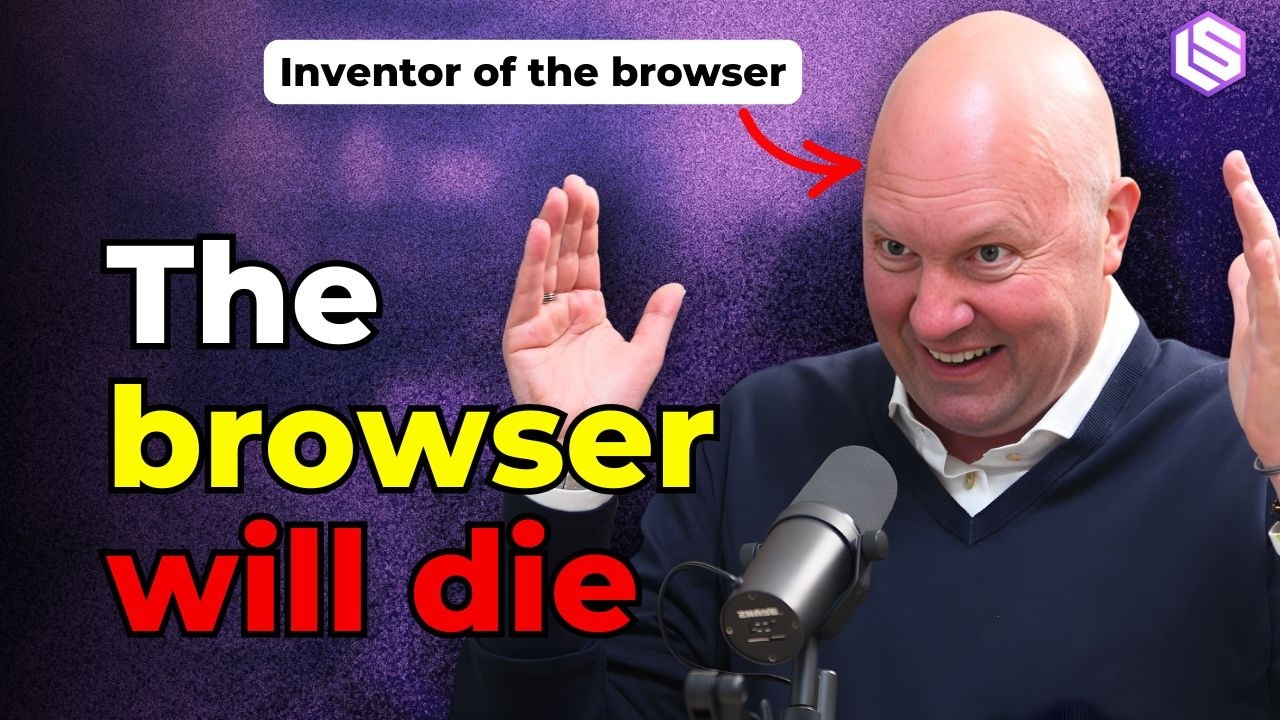 77 min
Marc Andreessen introspects on Death of the Browser, Pi + OpenClaw, and Why "This Time Is Different"
 67 min
Moonlake: Multimodal, Interactive, and Efficient World Models — with Fan-yun Sun and Chris Manning
 38 min
The Stove Guy: Sam D'Amico Shows New AI Cooking Features on America's Most Powerful Stove at Impulse
 55 min
Mistral: Voxtral TTS, Forge, Leanstral, & Mistral 4 — w/ Pavan Kumar Reddy & Guillaume Lample
Found this useful? Build your knowledge library
Get AI-powered summaries of any YouTube video, podcast, or article in seconds. Save them to your personal pods and access them anytime.
Get Started Free