Key Moments
The AI Cold War, Signalgate, CoreWeave IPO, Tariff Endgames, El Salvador Deportations
 All-In Podcast
Want to know something specific about what's covered?
We've already dissected every moment. Ask and we will deliver (with timestamps).
Key Moments
AI race, CoreWeave IPO, tariffs, SignalGate leak, and El Salvador deportations discussed.
Key Insights
Nvidia's accounting practices, particularly accounts receivable, are understandable given the monumental Blackwell GPU transition, akin to an iPhone upgrade cycle.
CoreWeave's IPO highlights investor skepticism due to debt and customer concentration, but its operational expertise in managing large GPU clusters may be underestimated.
US export controls aim to slow China's AI chip development, potentially incentivizing China to innovate its own semiconductor ecosystem.
AI agents, enabled by protocols like MCP, could unlock complex tasks and boost AI ROI, but compute power remains a bottleneck.
Debate on US tariff policy centers on re-shoring manufacturing, balancing economic incentives with potential inflation and retaliatory measures.
The SignalGate leak exposes security protocol failures in government communication, raising legal and transparency questions regarding official record-keeping.
El Salvador deportations, using the Alien Enemies Act, raise severe concerns about due process, human rights, and the potential for innocent individuals to be wrongly imprisoned.
NVIDIA'S ACCOUNTING AND THE BLACKWELL TRANSITION
Gavin Baker addresses concerns about Nvidia's balance sheet, particularly accounts receivable. He explains that the significant increase is largely due to the complex transition from the Hopper to the Blackwell GPU architecture. This transition, likened to a major product cycle like the iPhone, requires substantial infrastructure changes for customers, leading to higher receivables as revenue is recognized during deployment. Baker suggests this is a understandable, though not ideal, situation given the scale of the upgrade.
COREWEAVE IPO AND THE NEO-CLOUD LANDSCAPE
The discussion touches on the CoreWeave IPO, noting investor skepticism due to its substantial debt and reliance on Microsoft for a significant portion of its revenue. However, the panelists suggest that the company's expertise in operating large-scale GPU clusters—a complex task often underestimated—might be a differentiating factor. The IPO is seen as a milestone, potentially signaling a broader rebound in the IPO market and a competitor to the established cloud giants.
THE AI COLD WAR AND CHINA'S SEMICONDUCTOR GOALS
The US strategy of implementing export controls on advanced AI chips to China is analyzed. While intended to slow China's AI development, this policy is seen as creating strong incentives for China to accelerate its own semiconductor innovation. Although creating a competitive alternative to Nvidia within ten years is considered difficult, the long-term efforts by China are acknowledged, framing the AI race as a geopolitical competition with long-term implications.
THE RISE OF AI AGENTS
The emergence of AI agents, exemplified by companies like Manis, is discussed as a potential 'ChatGPT moment' for agentic capabilities. The development of protocols like the Model Context Protocol (MCP) is seen as crucial for standardizing agent interactions with various services. While agents promise high ROI and the ability to tackle complex tasks beyond human current capacity, compute power is identified as a significant limiting factor for widespread adoption, potentially driving up costs for early services.
TARIFF POLICY AND ECONOMIC REALIGNMENT
The conversation delves into the complexities of US tariff policy, particularly under a potential Trump administration. The core idea is to create economic incentives for reshoring manufacturing, addressing perceived historical trade imbalances. However, panelists highlight the delicate balancing act required to avoid inflation, retaliatory tariffs, and unintended consequences, stressing the need for deregulation alongside tariff implementation to maximize the chances of success.
SIGNALGATE: SECURITY FAILURES AND TRANSPARENCY DEBATES
The inadvertent inclusion of a journalist in a high-level Signal group planning military strikes is scrutinized as a serious security lapse. The incident highlights potential failures in government communication protocols and the use of insecure platforms. This event reignites debates about the Federal Records Act, the importance of preserving official communications, and the balance between transparency and the need for candid internal discussions among officials.
EL SALVADOR DEPORTATIONS AND DUE PROCESS
The deportation of alleged gang members to El Salvador's notorious CECOT prison, utilizing the Alien Enemies Act, sparks significant concern over human rights and due process. While proponents argue for its effectiveness in combating crime, critics highlight the risk of sending innocent individuals to harsh conditions without proper legal recourse. The administration's assertive approach is questioned, with panelists emphasizing the core American values of due process and human rights.
THE ECONOMIC IMPLICATIONS OF DEPORTATION POLICY
The discussion around El Salvador deportations touches upon the trade-off between security and individual rights. The significant reduction in El Salvador's homicide rate is noted, but the lack of due process and the potential for wrongful detentions are major concerns for the US legal and ethical framework. Panelists question whether such a system, even if effective in reducing crime, aligns with American values, suggesting that alternative approaches prioritizing due process are essential.
GOVERNMENT EFFICIENCY AND OVERSIGHT
The potential for significant government savings through reducing waste, fraud, and abuse is explored. Howard Lutnick's proposal to offset deficit concerns by cutting inefficiencies is discussed. Panelists express skepticism about lofty revenue targets from tariffs alone, suggesting that substantial cuts to government spending and improved oversight are critical for fiscal health. The complexity of identifying and rectifying waste is acknowledged as a significant challenge.
COMMUNICATION AND EXECUTION IN GOVERNANCE
The importance of clear communication and effective execution in implementing ambitious government agendas is stressed. The SignalGate incident and the El Salvador deportations are presented as examples where missteps could undermine public trust and mandate. Panelists suggest that acknowledging mistakes, offering apologies, and demonstrating a commitment to fixing errors are crucial for maintaining credibility and achieving policy goals.
Mentioned in This Episode
●Products
●Software & Apps
●Companies
●Organizations
●Concepts
●People Referenced
Common Questions
The discussion addresses the significant increase in NVIDIA's accounts receivable, which is attributed to the complex transition from its Hopper to Blackwell GPU architecture. This is seen as understandable given the monumental product shift, similar to an iPhone upgrade cycle, but sustained high receivables past the July quarter would be a concern.
Topics
Mentioned in this video
A law providing access to government records, discussed as a mechanism for accountability and transparency.
A law allowing the president to detain individuals from enemy nations during invasion or incursion, used by the Trump administration for deportations.
A law requiring government officials to preserve official communications, discussed in relation to the Signal gate incident.
Mentioned in the context of the administration's explicit intentions regarding immigration and crime.
An organization that sued over the use of private email for official business, cited in a court case regarding record preservation.
An organization that sued the Trump Administration regarding record preservation, part of ongoing court cases on the matter.
An organization that sued the State Department regarding record preservation, involved in ongoing court cases.
Representing Andre Hernandez, arguing that his tattoos are not gang-affiliated.
An organization involved in a lawsuit against the Department of Homeland Security concerning record preservation.
Shoe salesman and social media influencer who fled Venezuela and was suspected of gang affiliation due to a tattoo.
Governor from South Dakota, visiting a prison in El Salvador and stating consequences for illegal immigration and crime.
Mentioned as a breeder of dogs, showcasing beautiful and well-behaved dogs.
Stylist and makeup artist seeking asylum who claims no criminal history and was arrested based on tattoos interpreted as gang-affiliated.
Mentioned humorously as a dog jumping on a table and potentially ruining Christmas dinner.
Mentioned as a respected macro investor and part of the administration's economic team, explaining their coherent theory.
Former pro soccer player and refugee mistaken for a gang member due to a tattoo and a social media post.
More from All-In Podcast
View all 424 summaries 85 min
World's First Trillionaire, Anthropic Fable Banned, The New Oligarchs, Iran Peace Deal
 102 min
Anthropic's Fable Backlash, Nationalizing AI, Inflation Heats Up & California’s Broken Elections
 68 min
All-In's Best Ideas Pitch Competition: 4 Investors Present Their Top Trades Live
 44 min
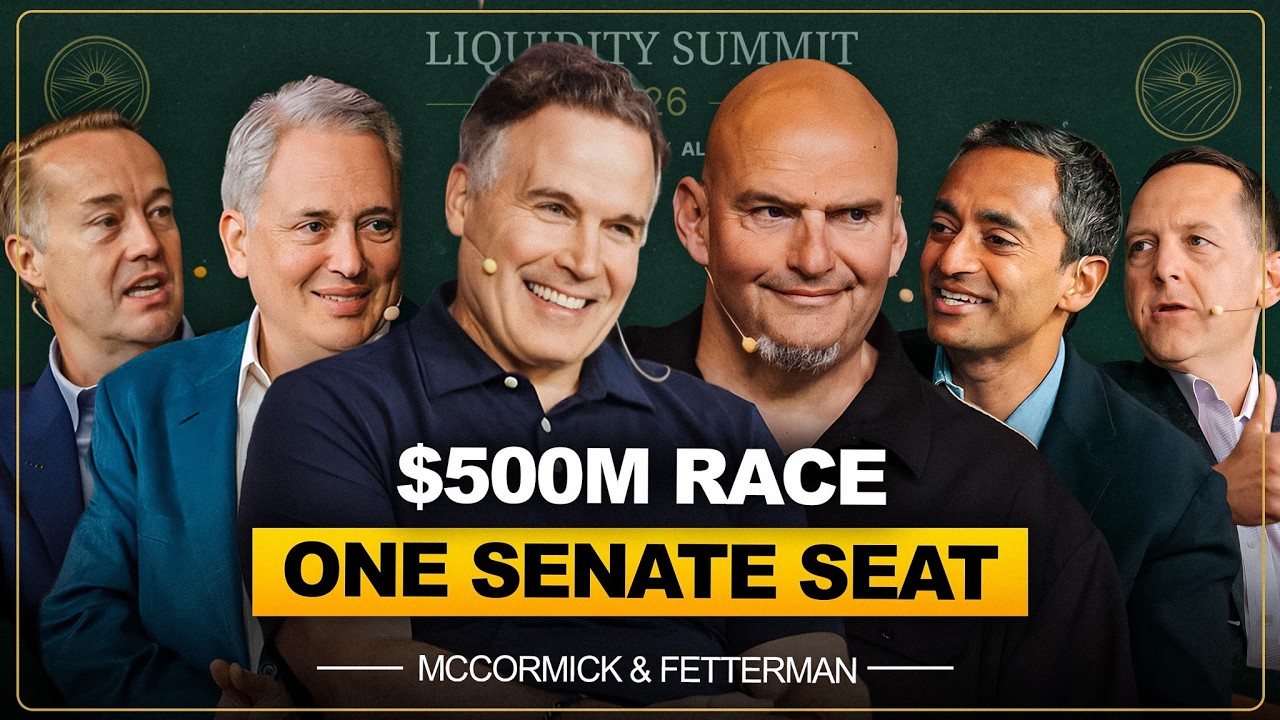
Senators John Fetterman and Dave McCormick: Bipartisanship, Money in DC, Datacenters, Graham Platner
Ask anything from this episode.
Save it, chat with it, and connect it to Claude or ChatGPT. Get cited answers from the actual content — and build your own knowledge base of every podcast and video you care about.
Get Started Free