Key Moments
Rodney Brooks: Robotics | Lex Fridman Podcast #217
 Lex Fridman
Key Moments
Rodney Brooks on robotics, AI, computation, and the future of intelligent machines.
Key Insights
Computation, as defined by Turing, is a powerful metaphor but may not fully capture biological intelligence.
Perception and mobility are fundamentally harder engineering challenges than pure reasoning for AI.
Human intelligence is deeply intertwined with social interaction and externalizing knowledge.
Progress in AI and robotics often comes from iterative engineering and real-world deployment, not just theoretical leaps.
Autonomous driving faces significant hurdles related to edge cases, public acceptance, and infrastructure.
The success of robots in the real world depends on understanding human expectations and developing compelling, useful products.
THE BEAUTY AND ORIGINS OF ROBOTICS
Rodney Brooks begins by describing "Domo," a human-like robot he considers mechanically gorgeous, highlighting the importance of exquisite detail in robotic design. He traces his own fascination with robots back to childhood books from 1961, which sparked his interest in building circuits and understanding concepts like the binary system. His early attempts at creating 'brains' for robots, using simple materials like ice cube trays, demonstrate a long-standing inclination towards the intellectual aspects of robotics, even while acknowledging limitations in mechanical construction.
COMPUTATION, INTELLIGENCE, AND THE LIMITS OF METAPHOR
Brooks delves into the history and definition of computation, tracing its roots from Napier and Kepler through Turing. He questions whether computation, as narrowly defined by Turing and easily implemented in silicon, is the correct metaphor for biological intelligence. He argues that disciplines like neuroscience, artificial life, and engineering all coalesced in the mid-20th century, often borrowing from computation, but this metaphor might be insufficient to understand consciousness and true intelligence, suggesting that complex phenomena like the behavior of a vibrating drum might not be purely computational.
THE HARD PROBLEM OF PERCEPTION AND MOBILITY
Challenging the common intuition that reasoning is the hardest part of AI, Brooks champions the Marvex paradox, which posits perception and mobility as far more difficult. He explains that early AI researchers focused on tasks like chess and calculus because they represented intellectual challenges, while basic perception was dismissed as easy. However, he argues that evolution spent millions of years perfecting perception and movement, and replicating these capabilities in robots, especially vision-based systems, remains a profound engineering challenge that current approaches often underestimate.
THE REAL-WORLD CHALLENGES OF AUTONOMOUS DRIVING
Brooks expresses a nuanced view on autonomous driving, particularly Tesla's Autopilot. While impressed by the engineering and widespread deployment, he emphasizes that current systems are far from fully autonomous and that public acceptance hinges on factors beyond mere technological capability. He highlights the long history of research in this area, the irrationality of expecting zero accidents, and the crucial role of infrastructure changes and societal adaptation, suggesting that true self-driving will likely involve significant modifications to our environment rather than just replicating human driving.
ROBOTICS COMPANIES: INNOVATION, FAILURE, AND IMPACT
Reflecting on his experiences co-founding iRobot and Rethink Robotics, Brooks discusses the immense difficulty of running successful robotics companies. He cites flawed founder expectations, mispricing products, and the challenge of consumer adoption as key hurdles. He proudly notes iRobot's success with Roomba and its critical role in the Fukushima disaster, underscoring the importance of real-world deployment and robust engineering. Rethink Robotics aimed to democratize robotics with affordable, safe collaborative arms, but faced market and technical challenges, ultimately highlighting the gap between ambitious visions and practical execution.
THE FUTURE OF INTELLIGENT MACHINES AND HUMAN CONNECTION
Brooks contemplates the potential for AI to develop deep connections with humans, even romantic love, though he believes we are far from genuine AI consciousness or reciprocal affection. He views the Turing test as a flawed metric, a "game of fooling people." He distinguishes intelligence from the ability to hold a meaningful, continuous conversation, which he believes requires a different kind of architecture and understanding. Ultimately, he hopes his written work will inspire a shift in thinking, contributing to future progress in understanding intelligence and our place in the universe.
Mentioned in This Episode
●Products
●Software & Apps
●Companies
●Organizations
●Books
●Concepts
●People Referenced
Common Questions
Domo is an upper-torso humanoid robot with two arms, three-fingered hands, and actuated eyeballs, built by Rodney Brooks's grad student Aaron Edsinger. Its beauty comes from its mechanically gorgeous and exquisite detailed engineering, with internal motors and cable-driven limbs allowing for interactive movement.
Topics
Mentioned in this video
A highly successful robotics company co-founded by Rodney Brooks, known for products like the Roomba.
A robotics company co-founded by Rodney Brooks that created collaborative robots like Baxter and Sawyer.
A British artificial intelligence subsidiary of Alphabet Inc., known for its work in AI game-playing and protein folding.
Google's autonomous driving technology company, discussed for its driverless taxi services in limited areas.
Elon Musk's aerospace manufacturer and space transportation services company.
An autonomous vehicle company whose vehicles Rodney Brooks observes in San Francisco, noting instances where they stop unexpectedly.
The latest company co-founded by Rodney Brooks, focused on teaching robots common sense.
A company that produced a specific chip with 512 bytes of RAM, which fit the budget and needs for the Roomba's computation.
A leading semiconductor foundry that enabled small companies to innovate by not requiring them to have their own fabrication facilities.
Technology company where Arthur Samuel oversaw early transistorized computers and used their production line for his chess learning program.
An autonomous vehicle company whose vehicles Rodney Brooks observes in San Francisco.
Mathematician whose problems were being disproved by Turing and Church in their foundational work on computation.
Roboticist and futurist known for Moravec's Paradox.
Computer scientist who created ELIZA, an early natural language processing program, and was surprised by the human desire to converse with it.
Director of MIT's CSAIL, whose office now houses the Domo robot.
Computer scientist and author of 'The Art of Computer Programming', who also addressed the definition of computation.
Former head of AI at Tesla, mentioned for his involvement in developing Tesla's data engine for autonomous driving.
A former graduate student of Rodney Brooks, who built the robot Domo, known for its mechanical gorgeousness.
One of the greatest roboticists in history, known for leading MIT's CSAIL, co-founding iRobot and Rethink Robotics, and Robust.AI. He is the guest of this interview.
Mathematician who, concurrently with Turing, disproved one of Hilbert's hypotheses.
Mathematician who designed the EDVAC computer and referenced the McCulloch-Pitts paper, linking computer components to neurons.
Influential AI pioneer and mathematician, described as struggling with the definition of computation and later co-authored 'Perceptrons'.
Co-author of 'Perceptrons' with Marvin Minsky, which severely hindered neural network research for a period.
Logician who had already disproved two of Hilbert's hypotheses before Turing and Church.
Billionaire entrepreneur, CEO of SpaceX and Tesla, whose companies and predictions are often a topic of Brooks's criticism or discussion.
A pioneer in AI and machine learning who developed a checkers-playing program capable of beating a world champion, benefiting from significant computational resources at IBM.
Pioneer in computing, had a vision for humans and computers working together, and funded Project MAC at DARPA.
Mathematician and computer scientist who formulated the Turing Test and wrote a foundational paper on computation.
Theoretical physicist, used metaphorically to explain that a robot's appearance should not over-promise its intelligence.
Mathematician and 'father of information theory,' who outlined a learning mechanism for chess-playing that Arthur Samuel used.
Philosopher and logician whose work inspired McCulloch and Pitts' paper on neural systems.
Philosopher who discusses the difficult concept of 'registration' in perception, which Brooks believes current AI systems lack.
Science fiction writer who formulated the Three Laws of Robotics.
The observation that the number of transistors in an integrated circuit doubles approximately every two years, which has driven powerful computational tools.
A type of artificial intelligence modeling that processes information using an interconnected structure inspired by the human brain.
A test of a machine's ability to exhibit intelligent behavior equivalent to, or indistinguishable from, that of a human.
The counter-intuitive discovery that high-level reasoning activities (like chess) are easy for computers, while low-level sensorimotor skills (like perception and mobility) are difficult.
A thought experiment in ethics that highlights the dilemma of sacrificing one to save many, applied to autonomous vehicle decision-making.
A set of rules conceived by Isaac Asimov to govern the behavior of robots and protect humanity.
A proposed high-speed transportation system, criticized by Brooks as being conceptually undeveloped compared to SpaceX's reusable rockets.
A type of machine learning where an agent learns to behave in an environment by performing actions and receiving rewards or penalties.
A mathematical theorem that was unsolved for centuries, used as an example of a problem too difficult for a human 'computer' to resolve as a simple step.
A field that applies computational methods to study the nervous system, viewed as a parallel to 'people are computers'.
A major AI research project at MIT, funded by DARPA, focusing on interactive computing.
A theoretical model of computation that manipulates symbols on a strip of tape according to a table of rules.
A beautiful upper-torso humanoid robot with three-fingered hands and actuated eyeballs, built by Aaron Edsinger, a grad student of Rodney Brooks.
DeepMind's AI program that mastered chess, shogi, and Go through self-play.
DeepMind's AI program that plays the board game Go.
A language model by OpenAI, mentioned as an example of surprising AI progress.
A company specializing in computer vision for advanced driver-assistance systems, initially used by Tesla for Autopilot.
An early natural language processing computer program that could mimic a Rogerian psychotherapist, surprising its creator with the human engagement it elicited.
Cadillac's advanced driver-assistance system, noted by the host as an interesting innovation.
Amazon's AI-powered virtual assistant, used as an example of current conversational AI and challenges in prolonged human-like interaction.
A large visual database designed for use in image recognition software research.
DeepMind's AI program for protein structure prediction, whose success was a scientific surprise despite current limitations in usefulness.
IBM's chess-playing computer, famous for beating Garry Kasparov.
One of the earliest electronic computers, whose design by John von Neumann considered components as neurons.
A 2021 model car owned by Rodney Brooks, whose machine vision and sonar capabilities impress him.
An early personal computer, used as a reference point for the 6802 microprocessor that inspired a stripped-down version for the Roomba.
A collaborative robot created by Rethink Robotics, designed to work safely alongside humans in factories.
iRobot's robotic vacuum cleaner, a highly successful consumer product developed with tight budget constraints.
An early home cleaning robot that sold for a much higher price (2000 euros) than iRobot's target price for the Roomba.
A collaborative robot created by Rethink Robotics, similar to Baxter, designed for safe human-robot interaction.
Tesla's advanced driver-assistance system, criticized by Brooks for its claims of full self-driving and reliance on vision-based methods.
Location in Japan where Rodney Brooks observed a fully autonomous train system.
A city Brooks discusses in the context of self-driving car deployment, noting its grid streets north of Market as a relatively benign environment.
A city where Waymo is considering expanding its driverless taxi services.
A city where Waymo operates fully driverless taxi services.
Site of a nuclear disaster in Japan where iRobot's military robots were deployed to assist in the shutdown, highlighting their real-world utility.
A neighborhood in Cambridge, MA, mentioned as a challenging environment for autonomous vehicles due to narrow roads and varied driving behaviors.
City where a fully autonomous mass transit train system was expected to operate in 2017.
A film cited as a good depiction of human-robot convergence, where humans adopt robot technology as robots become more human-like.
A science fiction film mentioned for its portrayal of falling in love with an AI voice assistant.
A science fiction film mentioned as having an unrealistic timeline for complex human-like AI interactions.
U.S. government agency that funded Project MAC, which was instrumental in early computing and AI research.
An interdisciplinary research laboratory at MIT, where one of Rodney Brooks's colleagues earned his PhD.
A city mentioned for its efforts to exclude cars, suggesting a potential shift in urban planning away from car-centric design.
A prestigious research university where Rodney Brooks led the Computer Science and Artificial Intelligence Laboratory (CSAIL).
A book by Minsky and Papert, published in 1968, that critically analyzed neural networks (perceptrons) and contributed to declines in neural network research.
Donald Knuth's multi-volume work that discusses computation and algorithms.
A mathematical book by Marvin Minsky from the mid-1960s, which discusses the nature of computation.
More from Lex Fridman
View all 547 summaries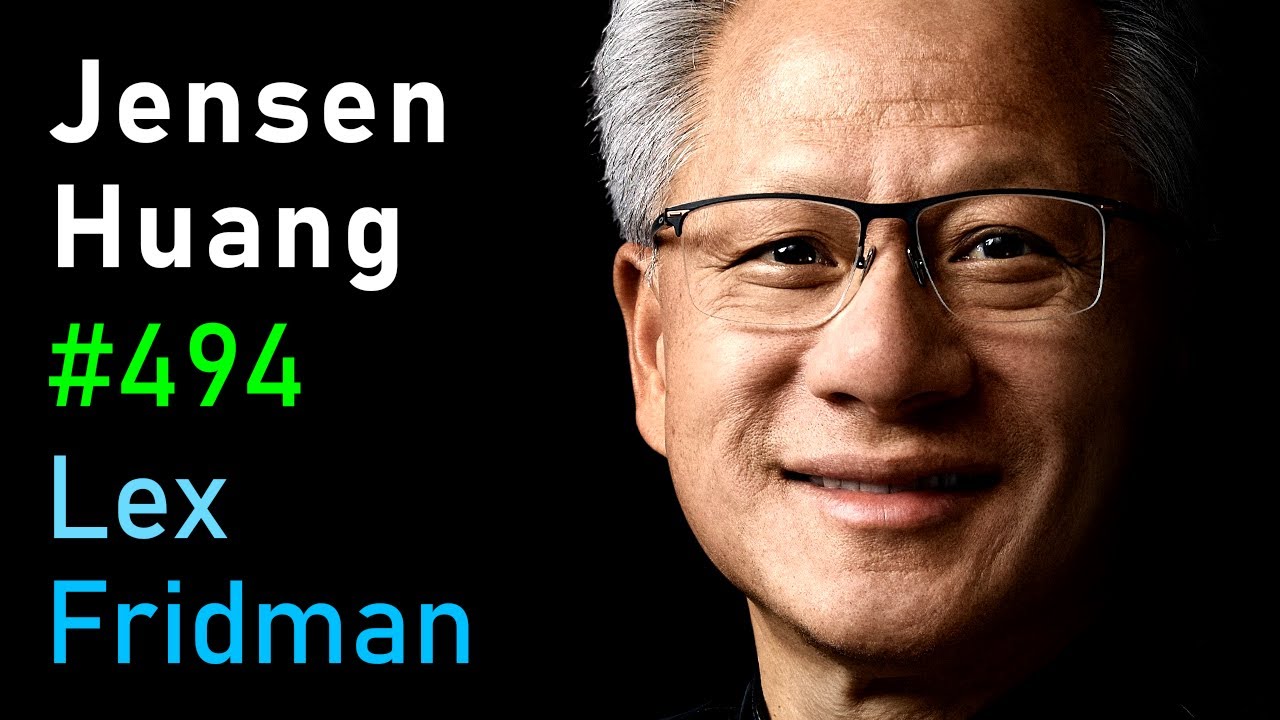 146 min
Jensen Huang: NVIDIA - The $4 Trillion Company & the AI Revolution | Lex Fridman Podcast #494
 311 min
Jeff Kaplan: World of Warcraft, Overwatch, Blizzard, and Future of Gaming | Lex Fridman Podcast #493
 154 min
Rick Beato: Greatest Guitarists of All Time, History & Future of Music | Lex Fridman Podcast #492
 23 min
Khabib vs Lex: Training with Khabib | FULL EXCLUSIVE FOOTAGE
Found this useful? Build your knowledge library
Get AI-powered summaries of any YouTube video, podcast, or article in seconds. Save them to your personal pods and access them anytime.
Get Started Free