Key Moments
Relentless Focus, Full-Contact Entrepreneurship, Epigenetic Reprogramming, and More
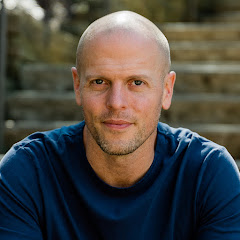 Tim Ferriss
Want to know something specific about what's covered?
We've already dissected every moment. Ask and we will deliver (with timestamps).
Key Moments
Brian Armstrong discusses entrepreneurship, the crypto economy, leadership, and the future of science and technology.
Key Insights
Early entrepreneurial lessons involved the importance of a blog over a book and the power of user feedback to find product-market fit.
Experiencing Argentina's hyperinflation and cultural lack of optimism highlighted the value of U.S. principles like individual empowerment and free markets.
Effective leadership requires making unpopular decisions for the long-term company vision, even if it causes short-term controversy.
Developing resilience to criticism involves cultivating a mindset of focusing on action and important goals, rather than external noise.
The future of crypto is promising, evolving from a speculative asset to a global, decentralized economy with increasing real-world use cases.
Investing in hard science and technology is crucial for societal progress, requiring cross-pollination between scientists and entrepreneurs.
EARLY ENTREPRENEURIAL JOURNEYS AND LESSONS
Brian Armstrong's entrepreneurial path began with writing a book before having a clear business idea, later realizing the impact of a blog for real-time feedback. He founded an online tutoring company and experienced periods of uncertainty before co-founding Coinbase. A significant early lesson came from realizing the critical need for a simple 'buy Bitcoin' button on Coinbase, which was directly inspired by user feedback indicating the complexity of acquiring cryptocurrency was a major barrier to adoption.
INFLUENCES AND CULTURAL OBSERVATIONS
Armstrong cites Richard Feynman's curiosity and zest for life as influential, promoting a mindset of continuous learning and treating life as a game. He also references Ray Dalio's 'Principles for a Changing World Order,' suggesting a slow decline in the U.S. and raising questions about the next global order. His experience in Buenos Aires during Argentina's economic instability provided a stark contrast to U.S. optimism, highlighting the negative effects of prolonged mismanagement and corruption on a nation's outlook.
LEADERSHIP AND NAVIGATING CORPORATE CULTURE
A pivotal leadership moment occurred at Coinbase when internal activism around social issues led to employee walkouts. Armstrong's decision to establish Coinbase as a mission-focused, apolitical company, offering generous severance to dissenters, was controversial but ultimately aimed at fostering internal alignment. He emphasizes that true leadership involves making difficult, sometimes unpopular decisions for the long-term health and mission of the company, rather than seeking consensus.
BUILDING RESILIENCE AND FOCUS
Armstrong acknowledges that he has cultivated resilience to external criticism, recognizing that people often root for failure. His strategy involves filtering out online noise, focusing on high-impact actions, and surrounding himself with trusted advisors who provide candid feedback. He views negative press as a rite of passage for entrepreneurs, a sign of growth and a superpower allowing for decisions based on conviction rather than fear of reaction.
THE FUTURE OF CRYPTO AND INNOVATION
Armstrong believes crypto is still in its early stages, comparing its trajectory to the internet's growth. He distinguishes between crypto skeptics who miss its potential and overly enthusiastic bulls focused on quick gains. Key drivers for broader adoption include regulatory clarity and blockchain scalability. He sees significant use cases beyond trading, such as DeFi, NFTs, and real-world asset representation, underscoring the potential for crypto to fundamentally reshape the global economy.
ADVANCING SCIENCE AND TECHNOLOGY
Armstrong is passionate about using technology to improve the world, extending his focus to hard science. He co-founded NuScale, a longevity company exploring epigenetic reprogramming, and Research Hub, which aims to make scientific research more open-source and collaborative, akin to GitHub. He believes in the power of cross-pollination between scientists and entrepreneurs to drive innovation and solve major global challenges like climate change and improving financial infrastructure.
PERSPECTIVES ON NANO-TECHNOLOGY AND ENTREPRENEURSHIP
Armstrong expresses excitement about decentralized identity and the creation of stablecoins linked to purchasing power rather than fiat currency. He sees significant opportunities in areas like decentralized social media and user-friendly platforms for crypto transactions, including NFTs. He also highlights the critical intersection of scientific innovation and commercialization, emphasizing the need for individuals who can bridge the gap between research and market application for the benefit of humanity.
THE UTILITY OF CRYPTO FOR INDIVIDUALS AND INSTITUTIONS
Coinbase offers both self-custodial wallets (Coinbase Wallet) for those who want full control and custodial solutions for users and institutions who prefer Coinbase to manage their assets. This dual approach caters to different needs and risk tolerances. Armstrong believes that while 'not your keys, not your crypto' is valid, robust security infrastructure and solutions like multi-party computation are essential for storing significant wealth, especially for institutions, and for individuals facing potential security threats.
THE CHALLENGE OF LONGEVITY AND BIOLOGY
Armstrong is actively learning about biology and longevity, inspired by research in epigenetic reprogramming which allows cells to be rejuvenated. He has invested in a biotech company, NuScale, aiming to develop therapies that can extend human healthspan. This reflects a broader theme of applying scientific advancements to solve fundamental human problems and improve quality of life.
BUILDING AND CONTRIBUTING TO THE FUTURE
Armstrong advocates for 'action over analysis,' summarized by his belief that the greatest risk is not taking one. He encourages people to pursue ambitious goals, emphasizing that fears are often greater in the mind than in reality. He celebrates builders and creators across various fields, including technology, science, and media, aiming to demystify the process of innovation and inspire others to contribute to positive global change through entrepreneurship and scientific advancement.
Mentioned in This Episode
●Software & Apps
●Companies
●Organizations
●Books
●Concepts
●People Referenced
Common Questions
Brian Armstrong started startbreakingfree.com as a blog after college, originally intending to write a book about entrepreneurship. He learned that blogging provided immediate audience feedback, which was more impactful than writing a book first. His takeaway was to start with a blog to gauge audience interest and then potentially package successful posts into a book.
Topics
Mentioned in this video
Cryptocurrency exchange founded in 2012 by Brian Armstrong, building the crypto economy and serving over 103 million verified users globally.
Traditional payment system used as a benchmark for transaction speeds, processing about 500 transactions per second, against which blockchain scalability is measured.
A biotech company co-founded and funded by Brian Armstrong and Blake Byers, aiming to radically extend human healthspan through epigenetic reprogramming of cells to restore function.
Online educational organization that provides free world-class education, cited as an exciting example of technology improving education.
Aerospace manufacturer and space transport services company, founded by Elon Musk, cited as an example of a valuable company that emerged from crossing scientific innovation with commercialization.
Company where Brian Armstrong worked as a software engineer focusing on fraud prevention before founding Coinbase. Also mentioned as a company whose founders went through Y Combinator.
Parent company of UniversityTutor.com.
Consulting firm where Brian Armstrong previously served as a consultant for the Enterprise Risk Management division.
Global payment technology company used as a benchmark for transaction speeds, processing about 4,000 transactions per second, and whose network Coinbase Card can leverage for crypto spending.
Financial institution used as an example to illustrate how high-value assets are protected with traditional security measures, comparable to the advanced multi-party computation tools in crypto.
A pioneering biotechnology corporation, cited as an example of a valuable company that emerged from crossing scientific innovation with commercialization.
Technology company that originated from a research project at Stanford with Larry Page and Sergey Brin, serving as an example of commercializing scientific innovation.
An online tutoring directory founded and CEO'd by Brian Armstrong prior to Airbnb, later a subsidiary of Johnson Educational Technologies LLC.
Social media platform where Brian Armstrong suggests people follow him; also mentioned as an example of social media where comments can be distracting.
A tool that helps entrepreneurs form a company, used as an analogy for a potential 'Stripe Atlas for crypto' to simplify DAO creation and token management.
Online auction and shopping website, used as an analogy for a potential 'eBay for crypto' for decentralized jobs and marketplaces.
E-commerce giant, used as an analogy for a potential 'Amazon for crypto' for decentralized jobs and marketplaces.
Technology company (formerly Facebook) with whom Coinbase has deals, indicating a broader institutional engagement in crypto.
A startup incubator that Coinbase went through, known for teaching entrepreneurs the 'startup hype cycle' and the importance of customer iteration.
A platform for software development and version control, mentioned as an example of a place where an early Bitcoin wallet app Brian Armstrong built might still exist.
Gaming company whose CEO, Bobby Kotick, often faces negative press, used as an example by Brian Armstrong to illustrate the common experience of public scrutiny for leaders.
Freelance platform (mentioned as Elance) used as an analogy for a potential 'Elance for crypto' for decentralized jobs and marketplaces.
Co-founder and CEO of Coinbase, interviewee on the Tim Ferriss Show.
Author of 'Getting Things Done', whose book offers practical advice on efficient task management, which Brian Armstrong roughly follows.
Co-founder of Google, who began the project as a research initiative at Stanford University.
Mutual friend of Tim Ferriss and Brian Armstrong, who observed Brian's resilience to criticism, noting his 'sticks and stones' attributes.
CEO of Activision, mentioned by Brian Armstrong as someone who receives negative press, illustrating how widespread such scrutiny is among CEOs.
A developer and Bitcoin advocate who maintains a GitHub repository documenting physical security threats related to Bitcoin, recommended for those wanting to understand risks.
Motivational speaker and ultramarathon runner, whose YouTube videos Brian Armstrong watches for motivation when feeling unmotivated to exercise.
Nobel Prize laureate (2006) for discovering that skin cells could be reprogrammed into stem cells using four transcription factors, foundational to the work at NewLimit.
Ph.D. scientist and partner at Google Ventures, with whom Brian Armstrong partnered to fund NewLimit, leveraging his scientific and biotech investment expertise.
Co-founder of Google, who began the project as a research initiative at Stanford University.
10-time Emmy award-winning filmmaker who worked with Coinbase for three years on a documentary about cryptocurrency and Coinbase, titled 'Coin'.
Co-founder of Coinbase who joined shortly after Brian Armstrong launched the early version of the platform. Described as a trusted colleague who can offer candid feedback.
Physicist and author of 'Surely You're Joking, Mr. Feynman!', lauded by Brian Armstrong for his curiosity, boundless energy, and experimental approach to life.
Co-founder of Apple, quoted by Brian Armstrong for his insight that 'everything around you was made by somebody else who just decided like you don't have to just consume the world'.
Co-founder of Y Combinator and author of influential essays like 'How to Make Wealth' and 'Haters', which Brian Armstrong cites for insights on wealth creation and dealing with criticism.
Author of 'Principles for a Changing World Order,' which Brian Armstrong found convincing for its historical patterns in economic and political cycles.
An early supporter and influencer who encouraged Tim Ferriss to buy his first Bitcoin on Coinbase, shortly after the 'buy Bitcoin' button was introduced.
Economist and author of 'Free to Choose', whose TV series influenced Brian Armstrong's global macroeconomic view, despite its libertarian stance.
Author of 'The Coddling of the American Mind', mentioned by Brian Armstrong when discussing the rise of activism and polarization within companies.
Stock exchange where Coinbase publicly listed in April 2021 under the ticker 'COIN'.
Venture capital arm of Alphabet Inc. where Blake Byers is a partner, investing in numerous biotech companies.
Prestigious university where Google originated as a research project, demonstrating the potential for academic innovation to become commercialized.
The world's largest asset manager, mentioned as a key partner with whom Coinbase has closed deals to facilitate more institutional money flowing into crypto.
University where Brian Armstrong earned a BA in Computer Science and Economics and an MS in Computer Science.
The capital city of Argentina where Brian Armstrong resided for a year, using it as a base for travel in South America and observing the local culture and economic conditions.
Social justice movement that Coinbase was asked to publicly support during the George Floyd riots, which prompted internal debate on the company's mission and political involvement.
A book by David Allen about personal productivity and task management, which Brian Armstrong reads for efficient work completion.
A book spotted in a snippet of the documentary while Brian Armstrong was packing, indicating a momentary interest in getting a dog.
A book by Milton Friedman, also a PBS TV series, which Brian Armstrong found interesting for its global macro environment and country analyses from a libertarian perspective.
An essay by Paul Graham (January 2020) that Brian Armstrong re-reads when feeling down about online comments and criticism, emphasizing tuning out negativity.
An essay by Paul Graham (May 2004), originally from 'Hackers and Painters', that Brian Armstrong rereads, explaining value creation as a non-zero-sum game.
A book by Paul Graham, from which the essay 'How to Make Wealth' originated.
A book by Jonathan Haidt, read by Brian Armstrong to understand the roots of activism and social issues impacting corporate culture, initially on college campuses.
A book by Ray Dalio that Brian found convincing for its historical analysis of economic and political patterns, suggesting a slow decline for the US.
A classic book by Richard Feynman, admired by Brian Armstrong for its humor and its message of lifelong curiosity and treating life like a video game.
A platform funded by Brian Armstrong that aims to make scientific research more open-source and collaborative, similar to GitHub, addressing issues like the replication crisis and siloed academic research.
A documentary about cryptocurrency and Coinbase, produced by filmmaker Greg Kohs, available on Amazon, iTunes, Vimeo on Demand, and other platforms.
A blog started by Brian Armstrong right out of college, which eventually led to a book he wrote to understand entrepreneurship better.
A well-known standard for decentralized identity, allowing for human-readable crypto addresses, similar to domain names for IP addresses.
A self-custodial crypto wallet offered by Coinbase, designed for users who want to hold their own keys; also offers free ENS names.
Coinbase's NFT marketplace, launched to make collecting and owning NFTs easier, aggregating supply from other marketplaces and integrating into the main Coinbase app.
Coinbase's institutional product for large institutions, now equipped to store NFTs, expanding beyond traditional crypto assets.
Blockchain platform mentioned for its scalability, previously processing 25 transactions per second, and for its 'Merge' event which was an incredible technical accomplishment aimed at improving scalability.
A high-performance blockchain platform, listed alongside Ethereum as working on scalability improvements.
Decentralized digital currency, whose birth Brian Armstrong ironically linked to the 2008 financial crisis; initially seen as a growth tech stock but expected to become more of a digital gold equivalent.
A blockchain platform, (likely misspoken as 'Salon' - Solana is another example) noted for contributing to scalability efforts alongside Ethereum.
A delivery mechanism for therapies, with a strong proof point from COVID vaccines, deemed interesting for future epigenetic reprogramming applications at NewLimit.
A gene editing technology, mentioned as an area of biology where tools are starting to make it feel more like engineering than pure science.
A form of immunotherapy using T-cells engineered to fight cancer, mentioned as an area of biological progress that feels more like engineering.
A concept written about by Balaji Srinivasan, suggesting a future where online communities could form their own digital nations.
A 'Layer 2' payment protocol built on top of Bitcoin, aimed at enabling faster transaction speeds and better scalability for crypto.
More from Tim Ferriss
View all 705 summaries 108 min
The Random Show — AI Super Assistants, Dream Engineering, Wizards, Supplements, and More!
 121 min
How to Legalize Medical Psychedelics in Your Country — Tania de Jong on Australia’s Breakthrough
 70 min
Q&A with Tim — The Art of Male Friendship, Reinvention in The Age of AI, & More
 125 min
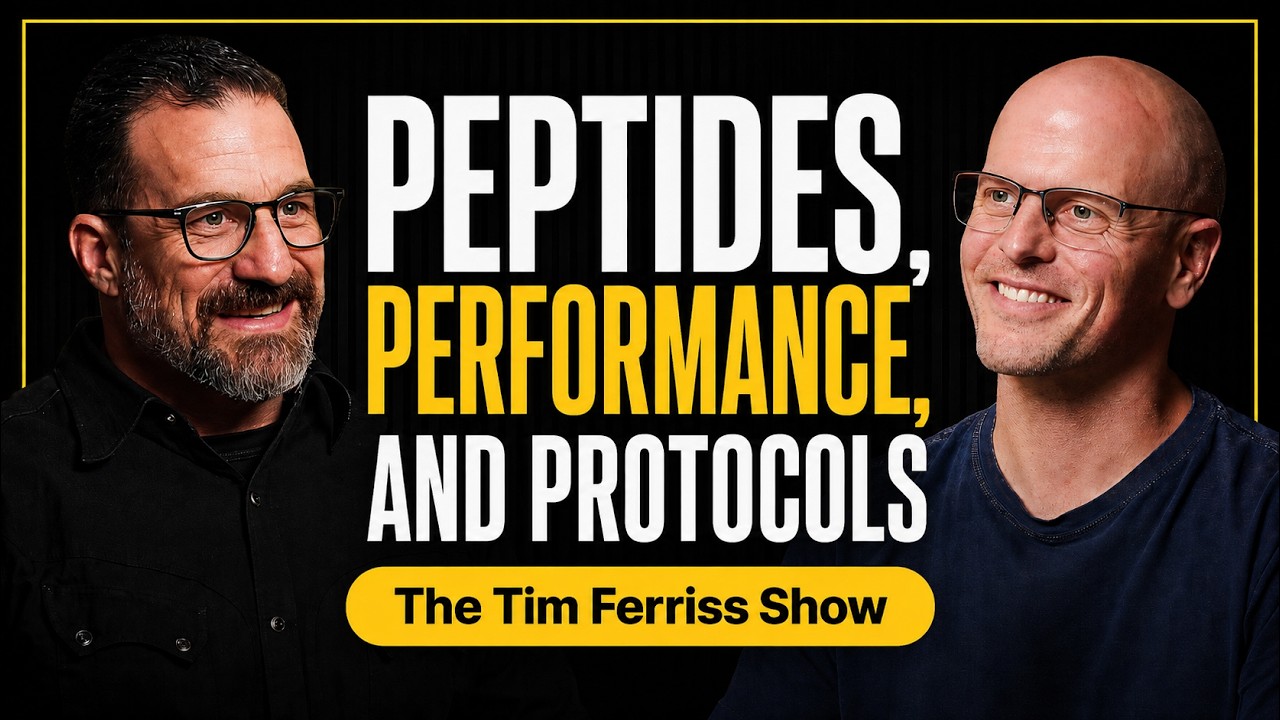
Dr. Andrew Huberman — Peptides, Performance, and Protocols
Ask anything from this episode.
Save it, chat with it, and connect it to Claude or ChatGPT. Get cited answers from the actual content — and build your own knowledge base of every podcast and video you care about.
Get Started Free