Key Moments
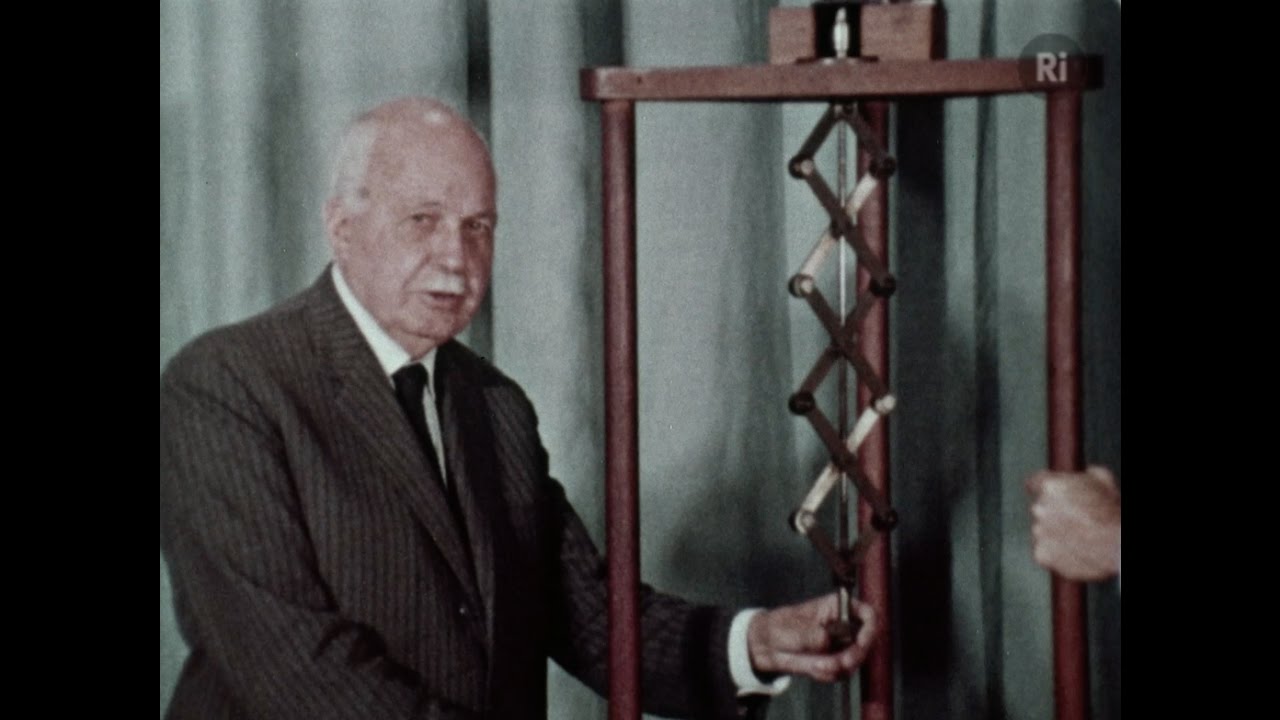
Magnetism #1 - with Sir Lawrence Bragg
 Royal Institution
Want to know something specific about what's covered?
We've already dissected every moment. Ask and we will deliver (with timestamps).
Key Moments
Magnetism basics from loadstones to magnetic fields and induction.
Key Insights
Magnetism is an ancient, familiar phenomenon rooted in loadstones and compasses, yet its underlying nature remains partly mysterious.
Magnets have north and south ends; like poles repel and unlike poles attract, a simple rule demonstrated with common magnets.
Faraday reframed magnets as fields that alter space around them, introducing the idea of magnetic fields and lines of force.
Iron becomes magnetized when placed in a magnetic field, showing induction rather than inherent magnetism in the material itself.
Iron filings visually map a magnet's field, revealing lines of force that extend in all directions between poles.
Modern magnets are vastly stronger than early ones, and magnetic phenomena underpin practical technologies and navigation.
INTRODUCTION TO MAGNETISM
Magnetism appears as a familiar, almost magical effect in daily life, but its deeper nature is not fully understood. Bragg frames magnetism as a phenomenon we can observe directly through magnets, compasses, and everyday demonstrations, while noting that science often explains such phenomena in terms of simpler components like magnets and electricity. He emphasizes the historical context, showing how ordinary magnets and the Earth’s magnetic influence guide navigation, and sets up the topic as a bridge between intuitive experiences and deeper physical concepts.
ANCIENT ROOTS: LOADSTONES, COMPASSES, AND EARTH AS A MAGNET
Bragg traces magnetism to ancient discoveries, such as loadstones that attract iron and guided navigation by floating stones that always line up north–south. He discusses how the compass’s pointing direction arises from the Earth behaving like a giant magnet, with poles that attract or repel akin to a magnet’s own poles. The talk includes cultural touchstones, like the Chinese use of loadstones and Kipling’s literary reference, to illustrate how magnetism has long shaped human exploration and understanding.
POLES, ATTRACTION, AND REPEL: HOW MAGNET ENDS BEHAVE
A central, accessible property is that magnets have ends we call north and south, and their ends interact: like poles repel while unlike poles attract. Bragg demonstrates this with colorful poles, showing the repulsion of similarly colored ends and the attraction between red and blue ends. He emphasizes that this simple rule governs magnet behavior, whether in an everyday bar magnet or in larger assemblies, and it underpins the practical ability of magnets to lift, hold, and attract objects.
FIELD THEORY: FARADY'S VISION OF MAGNETIC SPACE
Moving beyond poles, Bragg introduces the concept that a magnet alters the space around it, creating a magnetic field. This field is a landscape that guides how other magnets and magnetic materials behave. He recalls Faraday’s insight that the effect of a magnet extends through space, and that the direction of lines of force can be mapped much like compass needles point along those lines. The idea shifts focus from end-to-end interactions to the geometry of space shaped by magnetic sources.
INDUCTION: IRON BECOMES MAGNETIC IN A FIELD
Bragg demonstrates that placing iron near a magnet induces magnetism in the iron, turning a non-magnetic piece into a magnet within the field. A chain of iron objects can become magnetized successively as the magnetic influence propagates. This induction illustrates how magnetic effects can extend through materials that are not inherently magnetic, highlighting a dynamic interaction where the presence of a magnetic field imprints magnet-like behavior onto nearby matter.
VISUALIZING THE FIELD: IRON FILINGS, FLOATING MAGNETS, AND LINES OF FORCE
To visualize the invisible, Bragg uses iron filings scattered around a magnet to reveal lines of force—patterns that extend from one pole to the other in all directions. He also shows that strong magnetic materials can float or levitate when arranged to repel, an entertaining demonstration of magnetic fields acting in space. These images provide an intuitive map of the field, helping note-takers grasp how magnetism channels influence through space and through materials.
MODERN MAGNETS AND PRACTICAL TAKEAWAYS
Bragg closes by noting how modern magnets have become vastly stronger than traditional ones, reflecting advances in materials science. The discussion connects basic concepts to real-world applications, from navigation to technology, while reiterating that even Earth’s own magnetism remains a topic of inquiry. The talk positions magnetism as both a historical curiosity and a foundation for contemporary science and industry, inviting further exploration of how fields, induction, and material properties interact.
Mentioned in This Episode
●Products
●Tools
●Books
●People Referenced
Magnetism – Quick Do's & Don'ts
Practical takeaways from this episode
Do This
Avoid This
Common Questions
The speaker explains that the Earth behaves like a giant magnet. A compass aligns with the Earth's magnetic field and points toward magnetic north due to how the field interacts with the magnetized needle. This is demonstrated when a compass is placed near magnets and seen to align with the field.
Topics
Mentioned in this video
More from Ri Archives
View all 10 summaries 21 min
Young and the Wave Theory of Light - with Sir Lawrence Bragg
 25 min
Crystals - Alan Holden 1958
 25 min
Prelude to Power
 21 min
Plastics and Rubbers - Properties of Matter #4
Ask anything from this episode.
Save it, chat with it, and connect it to Claude or ChatGPT. Get cited answers from the actual content — and build your own knowledge base of every podcast and video you care about.
Get Started Free