Key Moments
Jeff Bezos: Amazon and Blue Origin | Lex Fridman Podcast #405
 Lex Fridman
Key Moments
Jeff Bezos on Amazon, Blue Origin, space exploration, and long-term thinking.
Key Insights
Childhood experiences on a ranch fostered self-reliance and problem-solving skills.
The Apollo program demonstrated that 'impossible' goals can be achieved with sufficient resources and determination.
Humanity's future lies in becoming a multi-planetary species, with vast space stations and resource utilization from the solar system.
Moving heavy industry off-planet is crucial for preserving Earth and enabling further human progress.
Effective decision-making involves distinguishing between reversible (two-way door) and irreversible (one-way door) choices.
Nurturing a culture of "Day One" thinking, customer obsession, and truth-telling is vital for long-term organizational success.
AI is a powerful discovery, not yet an invention, offering immense potential for good, but requiring careful management.
Long-term thinking, symbolized by the 10,000-year clock, is essential for addressing humanity's most significant challenges.
CHILDHOOD LESSONS IN SELF-RELIANCE
Jeff Bezos's formative years spent on his grandfather's ranch in Texas instilled deep values of self-reliance and problem-solving. He learned to fix machinery, build fences, and vaccinate animals, mirroring his grandfather's resourceful approach to life. The challenging summer spent repairing a broken-down bulldozer with his grandfather became a powerful metaphor for his own problem-solving methodology, emphasizing persistence and ingenuity over calling for external help.
THE INSPIRATION OF SPACE EXPLORATION
Bezos was profoundly inspired by the moon landing at age five, which instilled a lifelong passion for space. He views the Apollo program as a testament to human potential, demonstrating that seemingly impossible goals can be achieved through focused effort and significant resource allocation. The early space race, despite its dangers, highlighted the importance of pushing boundaries and inspired the naming of Blue Origin's rockets after pioneers like Gagarin and Shepard.
A VISION FOR HUMANITY'S MULTI-PLANETARY FUTURE
Bezos envisions a future with a trillion humans living throughout the solar system, supported by vast O'Neill-style space colonies and the utilization of asteroid belt resources. This expansion is not about abandoning Earth but about preserving it by moving heavy industry off-planet and creating much more habitable space. This future requires giant space stations and advanced technology to support a thriving, large-scale civilization enjoying abundant energy and resources.
BLUE ORIGIN'S TECHNOLOGICAL AMBITIONS
Blue Origin is developing significant space infrastructure, including the New Glenn heavy-lift rocket, designed for cost-effective access to orbit. The rocket features advanced propulsion systems and materials like carbon composites and aluminum-lithium alloys. The company also focuses on reusability, particularly for the first stage of New Glenn, and is developing lunar landers like the Mark I and Mark II, aiming to reduce costs and enable sustained human presence on the Moon by utilizing lunar resources.
DECISION-MAKING AND ORGANIZATIONAL CULTURE
Bezos emphasizes rigorous decision-making processes, distinguishing between reversible 'two-way door' decisions and irreversible 'one-way door' decisions, which require a more deliberate approach. He advocates for "Day One" thinking to avoid organizational stasis and irrelevance. Key to this is customer obsession, a skeptical view of proxies (metrics that don't directly represent customer value), embracing external trends, and maintaining high-velocity decision-making by fostering a culture that supports truth-telling and empowers even junior employees.
THE POWER OF LONG-TERM THINKING AND AI
Bezos champions "long-term thinking," symbolized by the 10,000-year clock, as essential for addressing humanity's most significant challenges, like climate change or misuse of powerful technologies. He views AI, particularly large language models, as powerful "discoveries" rather than engineered inventions, offering immense potential for good but requiring careful management. While acknowledging risks, he is optimistic that AI will ultimately help humanity, emphasizing its role in problem-solving, medical advancements, and technological development.
Mentioned in This Episode
●Products
●Software & Apps
●Companies
●Organizations
●Books
●Concepts
●People Referenced
Common Questions
Jeff Bezos spent his summers on a ranch with his grandfather, learning self-reliance, persistence, and ingenuity through practical tasks like fixing windmills, laying fences, and repairing a D6 bulldozer.
Topics
Mentioned in this video
Brilliant individual who conceived the idea of the 10,000 Year Clock in the 1980s.
Astronaut quoted for his 'overview effect' experience, saying he realized 'you don't go to heaven when you die, you go to heaven when you're born' after seeing Earth from space.
A brilliant and humble friend of Bezos at Princeton from Sri Lanka, whose effortless mathematical skill showed Bezos he wasn't destined to be a theoretical physicist.
The NASA administrator, pictured with Jeff Bezos, related to the Mk1 lunar lander.
The first American in space (suborbital flight) and the namesake for Blue Origin's New Shepard rocket.
Two upper-stage variant liquid hydrogen engines powering the second stage of New Glenn, each with 160,000 lbs of thrust.
A rocket vehicle example that uses all hydrogen, noted for its effectiveness but not cost-effectiveness, illustrating the challenges of hydrogen fuel for booster stages.
Human-rated rocket highlighted as a historical exception for not having an escape system, unlike Apollo and Gemini.
Blue Origin's very large, heavy-lift launch vehicle, designed to carry about 45 metric tons to Low Earth Orbit, with a first launch targeted for 2024.
Blue Origin's suborbital rocket system named after Alan Shepard, which Jeff Bezos personally flew on.
Historic Apollo-era rocket, mentioned as a comparison for New Glenn's thrust capacity (New Glenn has a little more than half the thrust of Saturn V).
United Launch Alliance's rocket, whose first stage will also be powered by Blue Origin's BE-4 engines.
A very interesting spacecraft designed to carry up to 3,000 kg of payload to geosynchronous orbit or lunar vicinity, providing thermal management, electric power, compute, and communications.
Seven engines fueling the first stage of New Glenn, generating over 550,000 lbs of thrust each, using liquid natural gas and liquid oxygen.
A soap opera Jeff Bezos's grandfather was addicted to, which they watched together during summers on the ranch.
A video game mentioned as an example of how brains get rewired by engaging with new tools or experiences, leading to seeing game patterns in the real world.
A podcast that analyzes different business advice given by Jeff Bezos, recommended as a resource for listeners.
More from Lex Fridman
View all 547 summaries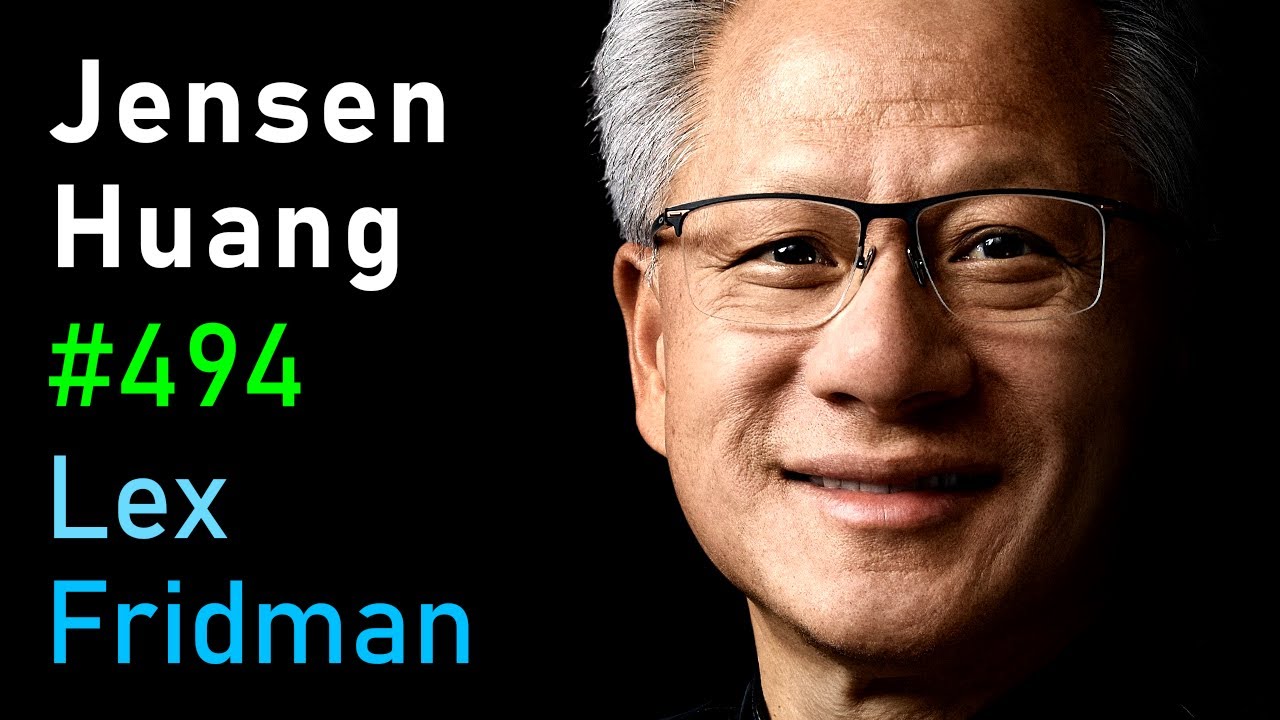 146 min
Jensen Huang: NVIDIA - The $4 Trillion Company & the AI Revolution | Lex Fridman Podcast #494
 311 min
Jeff Kaplan: World of Warcraft, Overwatch, Blizzard, and Future of Gaming | Lex Fridman Podcast #493
 154 min
Rick Beato: Greatest Guitarists of All Time, History & Future of Music | Lex Fridman Podcast #492
 23 min
Khabib vs Lex: Training with Khabib | FULL EXCLUSIVE FOOTAGE
Found this useful? Build your knowledge library
Get AI-powered summaries of any YouTube video, podcast, or article in seconds. Save them to your personal pods and access them anytime.
Get Started Free