Key Moments
How Electricity Actually Works
 Veritasium
Want to know something specific about what's covered?
We've already dissected every moment. Ask and we will deliver (with timestamps).
Key Moments
Electricity: Fields, not electrons, carry energy. Surface charges create fields guiding electrons.
Key Insights
Electrons are not the primary carriers of energy in a circuit; electric fields do.
The electric field in a wire is generated by both the battery and surface charges on the conductors.
Surface charges rearrange almost instantaneously to establish the electric field, limited by the speed of light.
Electrons are accelerated by the electric field and transfer energy to the lattice through collisions.
A simplified 'lumped element model' using voltage, current, and components is a convenient shortcut for complex field interactions.
Wires act as conduits to channel fields and energy efficiently, rather than being the direct source of energy.
CLARIFYING MISCONCEPTIONS ABOUT ELECTRON ENERGY TRANSFER
The video addresses a common misunderstanding that electrons directly carry energy from the battery to the bulb. While electrons do collide with the metal lattice in the filament, transferring kinetic energy and causing it to glow, this energy is not primarily from the electrons' journey from the battery. Instead, electrons are accelerated by an electric field within the wire. After each collision, they are re-accelerated by the same field, indicating that the energy originates from the field itself, not the electrons' initial kinetic energy.
THE ROLE OF ELECTRIC FIELDS AND SURFACE CHARGES
Contrary to the analogy of water flowing through a hose, mobile electrons do not push each other through a circuit. In conductors, the positive and negative charges largely cancel out, meaning repulsive forces between electrons are balanced by forces from positive ions. The crucial electric field that drives electron motion is generated by a combination of charges on the battery and, importantly, charges that build up on the surface of the wires and circuit components. This surface charge distribution creates a gradient that guides electrons.
INSTANTANEOUS SETUP OF SURFACE CHARGES
The electric field within the wires arises from both the battery's charge separation and the induced charges on the conductor surfaces. When a circuit is connected, these surface charges rearrange almost instantaneously. Even a slight shift in the electron sea is enough to establish the necessary charge distribution. This process is limited only by the speed of light, meaning the electric field is set up very rapidly, enabling a near-immediate response in the circuit.
THE FIELD AS THE PRIMARY ENERGY CARRIER
The concept of the electric field as the energy carrier is central to understanding circuits. When a switch is closed, the change in the electric field propagates at the speed of light. As this field reaches a load like a light bulb, it accelerates electrons in that localized area, causing current flow and energy dissipation. Simulations confirm that energy travels via fields, even across gaps, suggesting wires primarily serve to channel this field energy efficiently, rather than acting as the direct transport mechanism for energy.
THE LUMPED ELEMENT MODEL AS A CONVENIENCE
Analyzing circuits using Maxwell's equations in three dimensions is complex. Therefore, scientists and engineers use the 'lumped element model,' which simplifies circuits into discrete components like resistors, capacitors, and inductors. Quantities like voltage and current represent macroscopic results of underlying field interactions. This model, including Ohm's Law, is a highly effective shortcut for analyzing most circuits, but it abstracts away the fundamental role of fields and charge distributions.
TRANSMISSION LINE MODEL FOR HIGH-FREQUENCY CIRCUITS
For circuits with long wires or high frequencies, the spatial distribution of fields becomes critical. The 'distributed element model,' or transmission line model, incorporates these effects by considering the inductance and capacitance along the wires. This advanced model treats wires as continuous transmission lines, capable of carrying energy almost immediately to a load, as demonstrated by experiments showing visible light from an LED within nanoseconds, even with significant wire lengths.
EXPERIMENTAL VERIFICATION AND IMPLICATIONS
Experiments with scaled-down circuits and advanced simulations, like those using Ansys HFSS, validate the theory that current and voltage appear at the load very quickly after a switch is closed. The measured power transfer, though small, is significant enough to produce visible light, far exceeding leakage current. This confirms that energy is delivered via fields, impacting how we understand phenomena like remote charging and the necessity of proper trace routing in printed circuit board design.
Mentioned in This Episode
●Software & Apps
●Companies
●Organizations
●Books
●Concepts
●People Referenced
Understanding Electric Circuits: Key Takeaways
Practical takeaways from this episode
Do This
Avoid This
Experimental Measurement of Initial Voltage Across Resistor
Data extracted from this episode
| Time After Switch Closure | Voltage Across Resistor | Current Through Resistor | Power Transferred |
|---|---|---|---|
| ~4 nanoseconds | ~4 volts | ~4 milliamps | ~14 milliwatts |
Common Questions
Electricity doesn't primarily flow through the physical movement of electrons carrying energy. Instead, an electric field, set up by charges on the battery and surfaces of the wires, pushes electrons along the lattice. Electrons transfer energy to the lattice through collisions, causing heat and light.
Topics
Mentioned in this video
A veteran printed circuit board designer who emphasizes the importance of fields in circuits.
Helped with the scaled-down circuit model; works on LIGO, the gravitational wave detector.
A YouTuber who set up a kilometer of wire to test similar circuit concepts and got similar results.
An electrical engineer who made a response video and simulated the circuit model using Ansys HFSS.
More from Veritasium
View all 99 summaries 42 min
The Man Who Worked At Subway, Then Solved An "Impossible" Problem
 35 min
What Is Disrupting GPS Over Europe?
 30 min
How Does Google Maps Actually Work?
 22 min
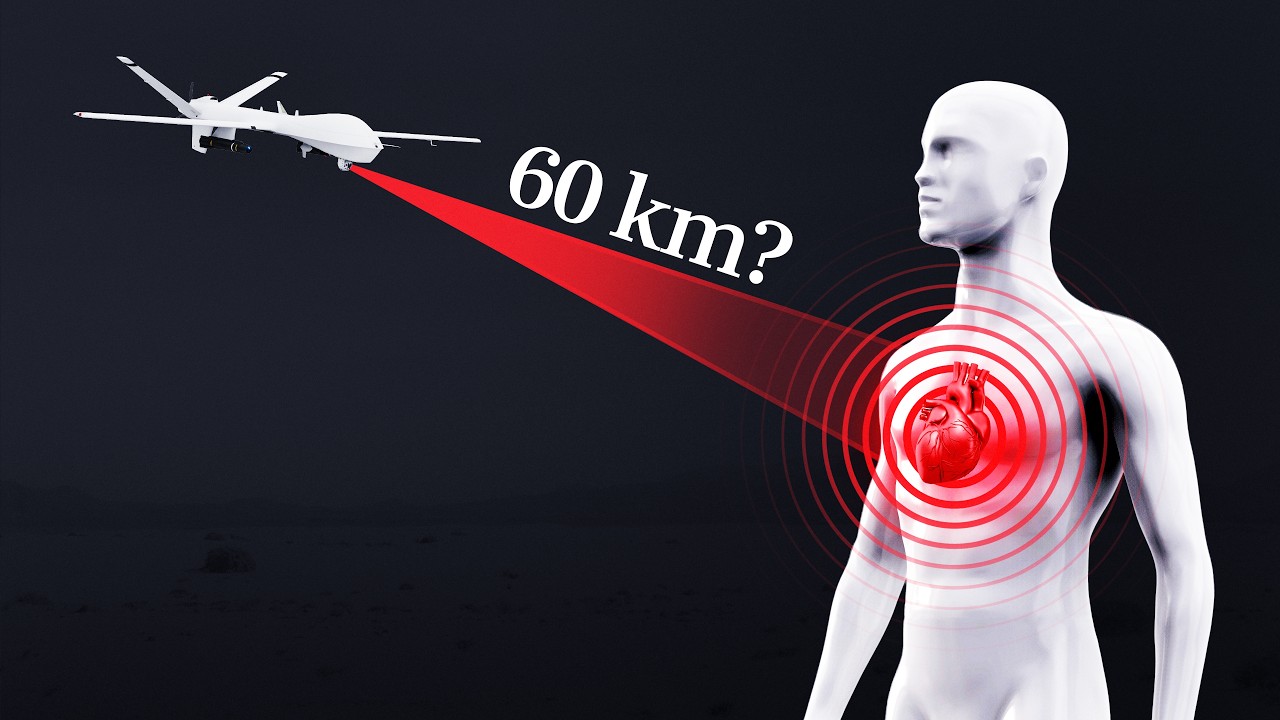
Can a quantum sensor detect your heartbeat from 60 km away?
Ask anything from this episode.
Save it, chat with it, and connect it to Claude or ChatGPT. Get cited answers from the actual content — and build your own knowledge base of every podcast and video you care about.
Get Started Free