Key Moments
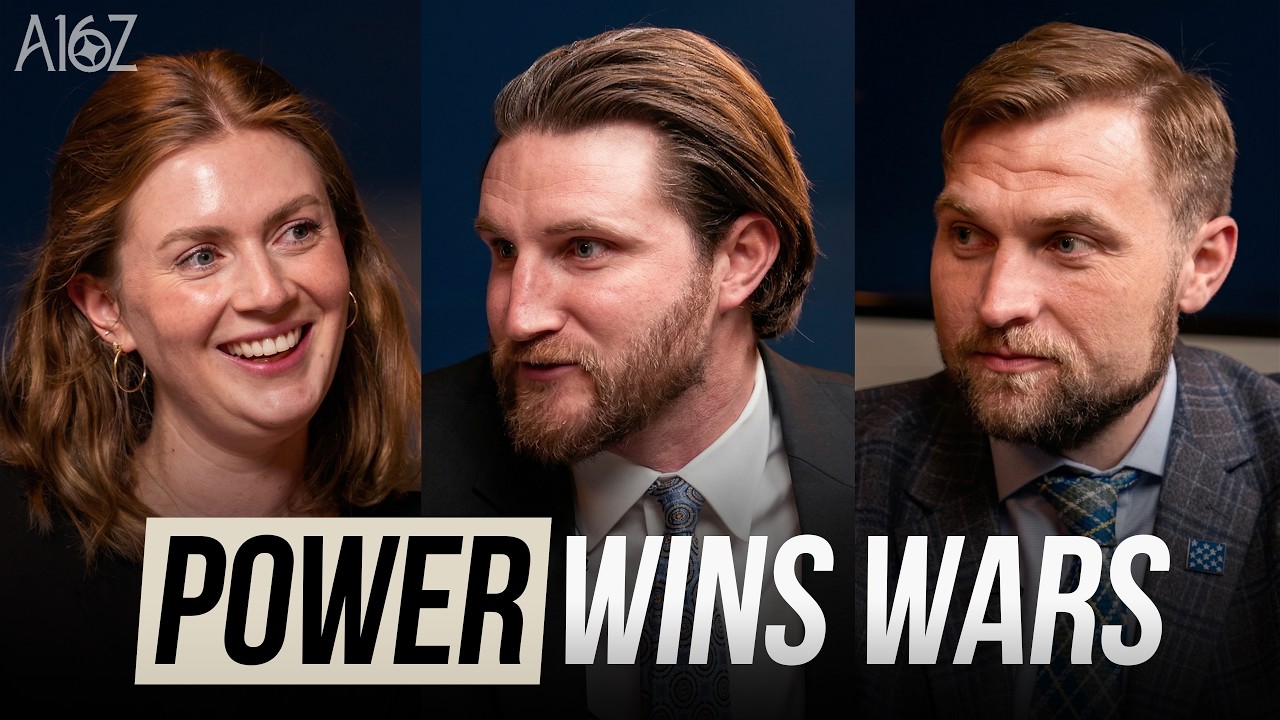
Submarines and the Future of Defense Manufacturing | Hadrian CEO on a16z
 a16z
a16zKey Moments
The submarine industrial base needs five times more manufacturing capacity than a decade ago, but a shortage of skilled labor means advanced software-driven factories and new workforce training are essential to meet demand.
Key Insights
The US Navy requires approximately 70 million hours of work to build new submarines and replenish its fleet, a more than fivefold increase from the roughly 13 million hours needed per Virginia-class submarine a decade ago.
At the end of the Cold War, the United States scaled back significantly on submarine manufacturing, leading to a loss of 9 out of 10 jobs in the sector.
The Navy's strategic deterrence mission relies on ballistic missile submarines as the survivable leg of the nuclear triad, ensuring a second-strike capability.
Hadrien's new Factory Four facility in Cherokee, Alabama, spans 2.25 million square feet and is designed to support the Columbia and Virginia class submarine programs.
A new 'Submarine SAR' role, officially a direct reporting portfolio manager, has been created within the Pentagon to streamline decision-making and accelerate submarine production.
Submarines are evolving beyond strategic deterrence, with potential roles in controlling networks of underwater drones and deploying tailored payloads for future conflicts.
The critical role of submarines in national defense
Submarines offer unparalleled stealth and access, allowing undetected global presence. They serve two primary missions: ensuring freedom of navigation for global trade routes through fast-attack submarines and providing strategic deterrence via ballistic missile submarines. These missile submarines carry nuclear weapons, forming the survivable leg of the U.S. nuclear triad and guaranteeing a second-strike capability that deters nuclear war by assuring adversaries of devastating retaliation. This strategic importance underscores the urgency of rebuilding and expanding the nation's submarine manufacturing capacity.
An unprecedented demand for manufacturing capacity
The U.S. submarine industrial base faces a significant capacity crisis. Following a drawdown in manufacturing after the Cold War, where production fell to about three submarines in the 1990s, the demand has surged. The current requirement to build new Columbia-class, replace Ohio-class ballistic missile submarines, and produce Virginia-class submarines necessitates around 70 million work hours. This represents a more than fivefold increase compared to the approximately 13 million hours required for a single Virginia-class submarine when built at a rate of one per year just over a decade ago. This massive uplift in required labor hours highlights the scale of the challenge in replenishing and modernizing the fleet.
The skilled labor deficit as a primary bottleneck
The core challenge in meeting the demand for submarine production is not a lack of capital, but a critical shortage of skilled labor. Post-Cold War de-emphasis on manufacturing led to the loss of approximately nine out of ten jobs in the sector. A generational gap has emerged, with many experienced workers in their late 50s and 60s, and a distinct lack of younger skilled workers entering the trades. To bridge this gap, the strategy involves a 'productivity jump' achieved by fusing advanced, software-driven factory capabilities with robust workforce training programs. Simply hiring more people is not feasible, as the required number of skilled welders, machinists, and inspectors simply does not exist in the country. Therefore, enhancing the productivity of the existing and newly trained workforce through technological augmentation is paramount.
Revolutionizing production with software-driven factories
Hadrien's new Factory Four facility exemplifies a modern, software-driven approach to advanced manufacturing. Unlike traditional factories focused on high-volume, uniform production (like car manufacturing), submarine production is characterized by 'high-mix, low-volume' requirements, demanding flexibility. This facility leverages software to augment the skills of a smaller workforce, making tasks easier and more accessible for training. It enables the factory to operate with the productivity of mass production while retaining the agility needed for varied and customized submarine components. This flexibility is crucial for meeting the complex demands of submarine construction, sustainment, and maintenance, allowing for on-demand reconfiguration of production lines and faster delivery of critical parts, thereby reducing costly delays.
Streamlining defense acquisition through centralized oversight
To address the urgency and complexity of rebuilding key defense manufacturing capabilities, the Pentagon has created new oversight roles. Vice Admiral Robert Gaucher has been appointed as the first direct reporting portfolio manager for submarines, colloquially known as the 'Submarine Tsar.' This role reports directly to the Deputy Defense Secretary and is designed to short-circuit bureaucratic hurdles, ensuring laser focus on outcomes like accelerating submarine production. Similar roles have been created for other critical deterrence missions, such as missile defense ('Golden Dome') and the Air Force's nuclear triad programs. This centralized authority model aims to enable faster decision-making, risk-taking, and the ability to place multiple strategic bets simultaneously.
Integrating submarines with emerging autonomous systems
The role of submarines in modern conflict is evolving beyond their traditional missions. They are envisioned as forward command-and-control hubs for fleets of autonomous underwater vehicles (AUVs) and drones. Submarines can provide secure networks, relay signals, and connect with these autonomous systems, allowing human operators to make critical decisions from a safe distance. While these unmanned systems are specialized and often expendable, the sophisticated systems and process knowledge gained from building them can inform modular construction for submarines. However, submarines retain their unique value as versatile, multi-mission platforms capable of performing a wide array of tasks, unlike the single-mission focus of most drones.
Addressing bottlenecks in the supply chain and production
Beyond workforce and software, specific bottlenecks within the supply chain and production process are being targeted. One significant opportunity lies in manufacturing obsolete parts for in-service submarines, allowing Hadrien to produce these critical components for aging vessels. Admiral Gaucher notes that human productivity in certain areas might be less than 50%, meaning for every two people, only one hour of work is effectively achieved. Augmenting human labor with machines is seen as key to increasing productivity and enabling round-the-clock operations. A major impediment is 'sequence critical material' – essential parts that halt progress if even one is missing. Capabilities like producing air flasks and hatches are being moved to facilities like Factory Four to ensure these critical items are available when needed, keeping the production lines moving.
Manufacturing submarines: A complex challenge of precision
Building a submarine is an exceptionally complex endeavor, often underestimated. Chris Power emphasizes that submarines represent one of the most challenging manufacturing tasks, potentially exceeding even the difficulty of building rockets like SpaceX's Starship in terms of tolerancing, precision, and welding quality. This high degree of precision and quality is non-negotiable, as the submarines must operate flawlessly underwater for decades, carrying sailors and ensuring national security. The transfer of this intricate knowledge from traditional naval shipyards and the Navy to new manufacturing partners is a significant undertaking. The success of this model relies on a national mission mindset, combining advanced software, dedicated workforce development, and a deep understanding of the intricate processes involved.
Mentioned in This Episode
●Products
●Companies
●Concepts
●People Referenced
Common Questions
Submarines offer unparalleled stealth and access, allowing them to operate undetected anywhere in the world. They are crucial for maintaining freedom of navigation and serve as a key component of strategic deterrence, ensuring a second-strike capability.
Topics
Mentioned in this video
A company focused on advanced manufacturing facilities, particularly Factory 4 in Cherokee, supporting submarine programs.
A class of submarines mentioned in the context of past production rates and the industrial capacity needed for current programs.
Ballistic missile submarines that are being replaced by the Colombia class, highlighting the increased work hours required for newer submarines.
Used as an example of high-volume, low-mix manufacturing (20,000 units/year) to contrast with the high-mix, low-volume needs of submarine production.
Founder and CEO of Hadrian, discussing advanced manufacturing, workforce training, and the challenges of defense industrial capacity.
In charge of all submarine production for the US Navy, discussing submarine missions, industrial capacity, and his role as a 'Submarine ZAR'.
Deputy Defense Secretary who created the direct reporting portfolio manager roles, including the 'Submarine ZAR'.
Mentioned as an example of traditional factory automation for mass production, like automating a million iPhones, to contrast with the flexibility needed for specialized manufacturing like submarines.
Mentioned in the context of Foxconn's manufacturing automation for iPhones, illustrating high-volume production capabilities.
A company mentioned as a builder of small, low-cost autonomous underwater vessels costing a fraction of a submarine.
A company building small, lower-cost autonomous underwater drones, discussed in comparison to large submarines and as a potential partner for module building.
Mentioned as a source of smart people needed to set up advanced manufacturing facilities, emphasizing the human element alongside automation.
Mentioned as a source of smart people required for advanced manufacturing setups, highlighting the need for skilled personnel.
More from a16z Deep Dives
View all 42 summaries 47 min
Privacy, Resilience, and Reinventing the Cellular Network | Cape CEO on a16z
 50 min
Why Modern War Needs Intelligent Power Systems | Chariot Defense CEO on a16z
 37 min
Are Tariffs Fueling the AI Race? | Deep Dives with a16z
 72 min
AI Copilots Are a Dead End. Here's What Actually Works | Kavak CEO
Found this useful? Build your knowledge library
Get AI-powered summaries of any YouTube video, podcast, or article in seconds. Save them to your personal pods and access them anytime.
Try Summify free