Key Moments
Gmail Creator Paul Buchheit On AGI, Open Source Models, Freedom
 Y Combinator
Key Moments
Paul Buchheit on AI's future: emphasizes open source and individual agency over AGI centralization.
Key Insights
Google's early vision was centered on AI, leveraging data for intelligence.
AI's progress has accelerated significantly since the early 2010s with deep learning.
Google's risk aversion, driven by preserving its search monopoly and regulatory fears, has hindered its AI dominance.
OpenAI's founding was a strategic move to democratize AI development and prevent its monopolization by large corporations.
Open source models are crucial for individual freedom and agency, countering centralization of power.
The path to AGI is debated, but a critical inflection point has been reached where investment yields significant advancements.
GOOGLE'S FOUNDATIONAL AI VISION
Paul Buchheit, creator of Gmail, highlights that Google was fundamentally conceived as an AI company. The core mission, though framed as organizing information, essentially meant feeding vast amounts of data into a powerful AI supercomputer. Early innovations like PageRank, now a foundational AI algorithm, underscore this AI-centric origin. Buchheit joined Google in 1999 when it was a small, electric startup, driven by the ambition to tackle significant technological challenges.
THE EVOLUTION OF AI AND DEEP LEARNING
Buchheit reflects on his early engagement with AI, building his first neural network in 1995. He notes the historical ebb and flow of neural network research, from initial excitement around perceptrons to later breakthroughs. The "early teens" marked a turning point with the rise of deep learning, producing impressive results and shifting AI from a distant sci-fi concept to a tangible, imminent future. This marked the beginning of a more definite AI trajectory.
EARLY GOOGLE INNOVATIONS AND 'DID YOU MEAN?'
Early AI applications at Google were practical, like the 'Did You Mean?' spell correction feature, which Buchheit developed due to his own spelling struggles and observations of query logs. This feature evolved from basic statistical filtering to a sophisticated system trained on web data and query logs, demonstrating the power of data-driven AI. A key hire, Goom Shazir, significantly advanced this feature, later becoming a pivotal figure in AI development, including the 'Attention is All You Need' paper and Character AI.
GOOGLE'S HESITATION AND THE RISE OF OPENAI
Despite possessing the data, compute, and talent, Google hasn't become the dominant AI company. Buchheit suggests this is due to a shift towards preserving its search monopoly and a deep-seated risk aversion, amplified by regulatory concerns around AI's potential for offensive outputs. This contrasts with OpenAI, which, emerging from YC, was positioned as a more open alternative. The launch of ChatGPT forced Google's hand, leading them to release a more sanitized version of their AI capabilities.
THE CRITICAL IMPORTANCE OF OPEN SOURCE MODELS
Buchheit strongly advocates for open-source AI models, viewing them as essential for preserving individual freedom and agency. He argues that the centralization of AI power in governments or big tech is catastrophic, diminishing individual capabilities. Open source is presented as a litmus test for freedom, akin to freedom of speech, ensuring that individuals retain the ability to think and express themselves without undue restrictions imposed by locked-down systems.
OPENAI'S ORIGINS AND THE OPEN SOURCE ADVANTAGE
The founding of OpenAI was motivated by a desire to build AI for the public interest, countering the trend of proprietary AI development. It attracted researchers by promising that their work wouldn't be locked away, a stark contrast to the restrictive environment at large corporations like Google. OpenAI offered a startup-like environment, allowing for faster iteration and innovation, which Buchheit believes was key to its success, especially compared to slower, more risk-averse incumbents.
THE PATH TO AGI AND THE CRITICAL INFLECTION POINT
Buchheit believes humanity is on a path to AGI, citing a critical inflection point where AI development has become a self-sustaining cycle of investment and advancement. This is analogous to the internet's explosion in the mid-90s. The massive investment in AI, including infrastructure like increased electricity supply, signifies its transition from a research project to a powerful, problem-solving technology that is rapidly improving.
DEBATES AROUND AGI AND 'SYSTEM 1' VS 'SYSTEM 2' THINKING
While Buchheit is optimistic about reaching AGI, he acknowledges ongoing research into bridging the gap between AI's current 'System 1' (fast, intuitive) thinking and 'System 2' (slower, deliberate human thought). He notes that current models, like ChatGPT, largely operate in a stream of consciousness, lacking the human capacity to pause, plan, and consider options. Future advancements will likely focus on incorporating these more complex cognitive processes.
THE FUTURE OF WORK AND AI'S IMPACT ON KNOWLEDGE WORKERS
Buchheit speculates about a future where AI can deeply learn the patterns of knowledge workers, potentially leading to AI agents that convincingly deepfake human employees on video calls. He predicts that within a decade, many 'Zoom-based' jobs could be transparently replaced by AI. This scenario highlights the potential for widespread job displacement and the need for societal visions beyond mere technological advancement. The distribution of AI's power—centralized control versus widespread agency—becomes paramount.
GEOPOLITICS, FREEDOM, AND THE DANGER OF AUTHORITARIAN AI
The geopolitical implications of AI are significant, particularly in the context of great power competition. Buchheit warns against authoritarian regimes developing super AIs, which could create inescapable totalitarian surveillance systems. He contrasts this with the advantage of freedom, which he believes is key to a more truth-seeking and optimistic AI future. Resisting legislation that imposes excessive liability on model builders is seen as crucial to maintaining this freedom.
THE ROLE OF STARTUPS AND INDIVIDUAL AGENCY
Buchheit emphasizes that Y Combinator and the broader startup community play a vital role in empowering individuals and fostering innovation. By creating more accessible AI tools, startups can inspire optimism and democratize capabilities. He believes that enabling everyone to be smarter and make better decisions collectively moves the world in a better direction, as opposed to top-down central planning. The ultimate goal is to increase individual agency, not diminish it.
THE 'DOOMER' MINDSET AND THE FIGHT FOR OPENNESS
The 'doomer' narrative, often advocating for central control and degrowth, has a long history, exemplified by past predictions of famine and environmental collapse. Buchheit contrasts this with the value of growth and freedom, championing open source AI. He believes that a maximalist approach to truth-seeking, as championed by groups like xAI, is essential, particularly when authoritarian regimes are inherently truth-denying and create disadvantages for themselves. The fight for open-source AI is a fight for individual freedom.
CORPORATE STRATEGY AND THE DEFLATIONARY POWER OF OPEN SOURCE
Meta's significant investment in open-source AI is seen as a strategic move to deflate the gross margins of closed-source competitors like OpenAI and Anthropic. By releasing powerful models that can be run on private hardware, Meta can significantly reduce the cost of accessing advanced AI, potentially undermining its rivals' business models. This also aligns with Meta's broader ambitions in areas like the metaverse, where AI is a foundational building block for augmented reality.
THE FUTURE OF AI AND THE IMPLICATIONS FOR HUMANITY
Looking ahead, the future of AI, including the potential for AGI, remains uncertain, raising questions about job markets, the existence of money, and even humanity itself. However, Buchheit is convinced that AI's trajectory is one of continuous improvement and problem-solving. The key determinant of a positive outcome lies in how the power of AI is distributed: whether it leads to centralized control or empowers individuals, ultimately shaping whether humanity thrives or becomes akin to 'zoo animals'.
Mentioned in This Episode
●Software & Apps
●Companies
●Organizations
●Studies Cited
●Concepts
●People Referenced
Common Questions
Paul Buchheit suggests Google's focus shifted to protecting its search monopoly after the transition to Alphabet. Fear of regulatory backlash and the disruptive nature of AI to its ad-based model also made the company extremely risk-averse, hindering its AI development and launch compared to competitors like OpenAI.
Topics
Mentioned in this video
Credited with inventing the 'did you mean' feature in his first two weeks at Google, and later being a key person on the 'Attention is All You Need' paper, and subsequently founding Character AI.
A legendary mathematician credited with the Hamming code. His lecture from the 80s/90s, which pinpointed human ego as a barrier to AI progress, is cited as still relevant today.
More from Y Combinator
View all 578 summaries 32 min
This AI Company Catches Fraud Across the Internet
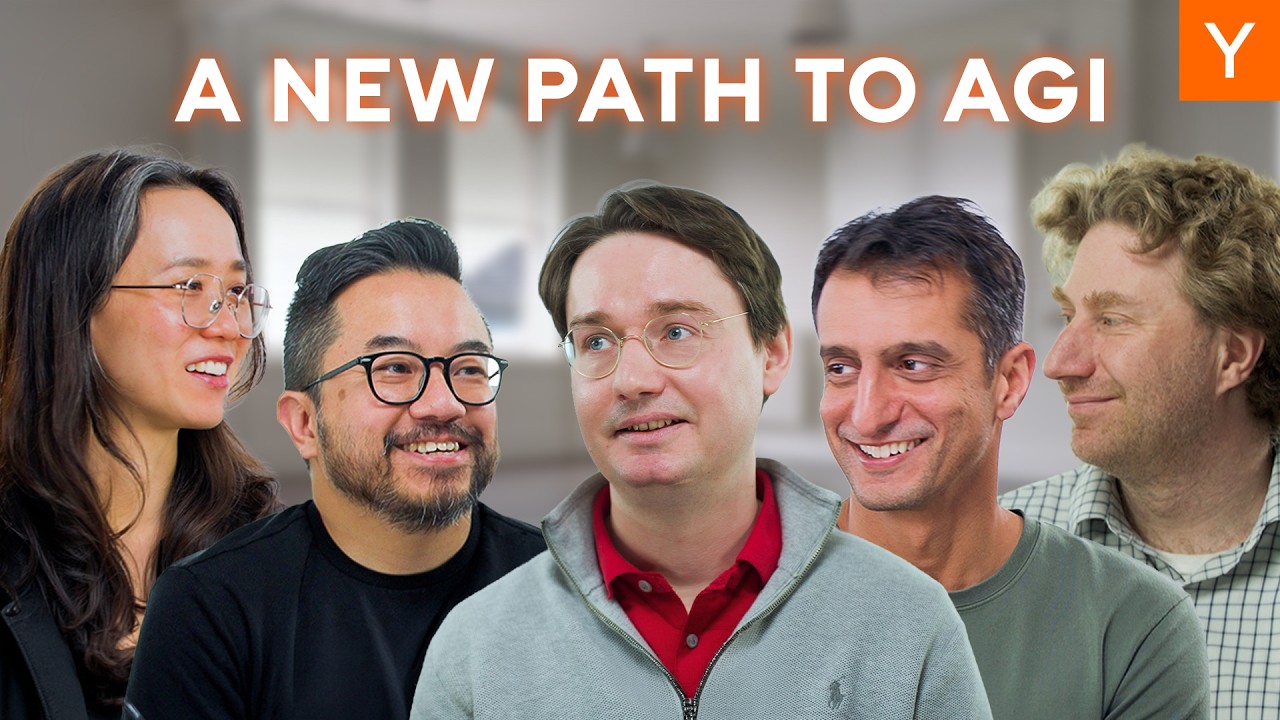 58 min
François Chollet: ARC-AGI-3, Beyond Deep Learning & A New Approach To ML
 14 min
Inside The Startup Reinventing The $6 Trillion Chemical Manufacturing Industry
 1 min
1 minThis Is The Holy Grail Of AI
Found this useful? Build your knowledge library
Get AI-powered summaries of any YouTube video, podcast, or article in seconds. Save them to your personal pods and access them anytime.
Get Started Free