Key Moments
Craig Foster of My Octopus Teacher — How to Find the Wild in a Tame World
 Tim Ferriss
Want to know something specific about what's covered?
We've already dissected every moment. Ask and we will deliver (with timestamps).
Key Moments
Craig Foster discusses finding wildness in modern life through nature, tracking, and deep connection.
Key Insights
Proximity to nature and biodiversity profoundly impacts human well-being, fostering calmness and a sense of belonging.
Indigenous tracking skills, like those of the San people, demonstrate a deep, almost instinctual connection to the environment.
True connection with nature stems from intimacy and observation, not just being in a biodiverse area.
Reconnecting with the 'wild self' is crucial for balance in our technologically advanced, 'tame' world.
Nature acts as a mirror, reflecting our inner states and offering profound lessons through animal behavior and ecosystems.
Language and storytelling are powerful tools for shifting perspectives and fostering conservation efforts.
EARLY IMMERSION IN THE OCEAN
Craig Foster's lifelong connection to the ocean began even before his birth, with his mother spending time in the water daily while pregnant. He was famously 'dunked' into the frigid Atlantic on the day he was brought home from the hospital, establishing a family tradition. This early and consistent exposure to the sea, including intertidal exploration and diving from a young age, shaped his deep affinity for the marine world and laid the foundation for his future explorations.
LEVERAGING ANCESTRAL TRACKING SKILLS
Foster draws parallels between ocean exploration and the ancient art of tracking, particularly inspired by the San people of the Kalahari. Their ability to 'run down' prey in extreme heat, relying on innate sensory abilities and an altered state of consciousness, highlights a profound connection to nature. This human capacity for deep tracking, also seen in Polynesian navigators, suggests an inborn 'radar system' that transcends mere visual cues, emphasizing a primal, instinctual way of knowing the environment.
THE JOY AND WISDOM OF THE WILD
Connecting with the wild, whether through observing the intricate lives of small creatures or experiencing the vastness of nature, brings an profound sense of joy and peace. Foster describes 'Wilderness Rapture,' an innate joy experienced by indigenous peoples deeply embedded in their natural surroundings. This connection isn't exclusive to remote wilderness; even in urban environments, focused observation of local flora and fauna can unlock a hidden world and foster a sense of interconnectedness.
UNDERWATER TRACKING AND ANIMAL RELATIONSHIPS
Foster's decade-long pursuit of underwater tracking has yielded unique insights. Unlike terrestrial tracking, where cues can be washed away, he discovered subtleties like mollusk slime trails and marks on animal hides. This deep immersion has allowed him to form special relationships with marine animals, including sharks and otters, fostering a sense of kinship. These interactions have de-emphasized his reliance on human relationships, enriching his understanding of interconnectedness and mutual respect.
THE AMORPHOUS SOUL AND MODERN EXISTENCE
In his book 'Amphibious Soul,' Foster explores the dichotomy between our wild, ancestral selves and the 'tame' world of technology and comfort. He emphasizes finding a balance, acknowledging that a complete return to a wild existence is impossible. The book encourages practices that retain wildness, leading to a more centered and calmer state, and suggests that reconnecting with nature is vital for navigating modern life and fostering a deeper relationship with oneself and the world.
NATURE AS A MIRROR AND THE POWER OF STORYTELLING
Foster posits that the natural world mirrors the human psyche, offering lessons and insights that extend beyond immediate observation. This mirrors are especially evident in areas of high biodiversity, where animal behavior can seem to reflect our own inner states or teach us profound truths. He stresses that effective conservation requires compelling storytelling and shifting perspectives, moving away from finger-pointing towards gentle, inclusive approaches that emphasize our interconnectedness with the planet.
THE PROFOUND LESSON OF 'HOME'
After losing his home to a fire, Foster had a profound realization that his true home was not a physical structure but the ocean and the planet itself. He recognized that the health of the biosphere and its biodiversity are fundamental to our existence and well-being. This experience underscored the importance of protecting and regenerating the natural world, as it forms the life support system for all investments and endeavors, and ultimately for our species.
PARENTING, LOVE, AND HERITAGE
Foster emphasizes instilling a love for nature in children through dedicated time and shared activities, drawing on his own experience of receiving deep, attentive love from his great-grandmother and grandmother. This unconditional love and focused attention provided meaning and a foundation from which to connect with the world. He advocates for sharing experiences that one enjoys, fostering a child's natural curiosity and deep, intrinsic connection to the natural world.
NAVIGATING SUCCESS AND REBUILDING THE NERVOUS SYSTEM
The overwhelming global success of 'My Octopus Teacher' led to a period of psychological distress for Foster, characterized by severe sleep deprivation and a shattered nervous system. He mitigated this by drawing on the lessons learned from nature and indigenous wisdom: immersion in the ocean, cold exposure, and focusing on tracking and ancestral connections. This process of rebuilding led to a deep humility and a realization that genuine connection and the impact on others were more meaningful than external accolades.
THE DELICATE ART OF CONSERVATION AND COMMUNICATION
Foster and Tim Ferriss discuss the difficulty of effective conservation communication, highlighting how polarizing language can hinder progress. They suggest finding common ground by focusing on observable phenomena, using evocative storytelling, and avoiding confrontational rhetoric. The goal is to gently guide people towards reconnecting with nature, fostering a sense of stewardship by emphasizing our intrinsic connection to the 'original mother'—the planet—rather than framing it as a battle or a plea.
PLAY, SONG CATCHING, AND MUSICAL EXPLORATION
The concept of 'song catching,' inspired by tracker John Young, involves tuning into the essence of a place or being and translating it into music. Foster's attempt to 'catch the song' of the kelp forest led to collaborations with musicians and the creation of unique underwater instruments from natural materials. This playful exploration, involving diving and experiencing sound in new ways with items like whale ear bones and kelp stems, highlights the creative potential of human-nature interaction and formed unexpected relationships.
REDEFINING CONNECTION: BEYOND SEPARATION
Foster and Ferriss challenge the notion of separation between humans and nature, emphasizing that we are an extension of the natural world. The idea of 'conserving nature' can imply a dichotomy that doesn't reflect felt experience. True integration involves recognizing our deep evolutionary heritage and innate connection to the planet, leading to a more holistic understanding of existence that transcends the 'skin-encapsulated ego' and fosters a sense of completeness, not through magic, but through altered perception and mindful interaction.
Mentioned in This Episode
●Organizations
●Books
●Concepts
●People Referenced
Common Questions
Craig Foster and marine biologist Jani du Plessis were studying Shaggy sea hares when a curious octopus unexpectedly grabbed their camera, leading to a unique perspective through the octopus's lens and inspiring 'My Octopus Teacher'.
Topics
Mentioned in this video
Author of 'Lion Tracker's Guide to Life,' a mutual friend who introduced the host to Craig Foster's work.
A Polynesian navigator who circumnavigated the world, known for using his body and stars for navigation, showing parallels with San trackers.
A professor who works with Craig Foster, often encountering new species and dealing with the rigorous process of officially describing them.
Author of 'The Wayfinders,' which includes a chapter on Polynesian navigation.
An incredible tracker and bird language expert from California, author of a definitive book on bird language, who also introduced the concept of 'song catching'.
Author of 'Of Wolves and Men,' described as a genre-busting and well-written book that pulls people into complex topics without lecturing.
An incredible Xhosa singer who participated in the 'song catching' project, remarkably able to catch songs from the kelp forest on her first dive.
A well-known author and responsible, ethical hunter who took the host on his first white-tailed deer hunt, challenging preconceived notions about hunting.
A master tracker from South Africa, friend of the host, involved with Tracker Academy. He is highly respected for his tracking abilities in the wild.
Craig Foster's wife, a conservation journalist from India, who grew up knowing about humans hunting with wild otters and named the 'Great African Sea Forest'.
Craig Foster's new book, exploring the balance between living a wild, connected life and functioning in the modern, 'tame' world. It aims to help readers reintegrate with nature.
A book by a Republican strategist (likely Frank Luntz, though not explicitly named) that analyzes how language influences narratives and policy, using examples like 'death tax'.
A book by Barry Lopez, praised for its nuanced exploration of wolves that transcends political divides and avoids lecturing.
A shy animal that engaged in a very intimate encounter with Craig Foster, demonstrating curiosity and potential ancient hunting collaborations with humans.
A hunting technique where hunters pursue prey over long distances until it can no longer run, often in high temperatures, leveraging human endurance and ability to sweat.
A species of shrimp named after Craig Foster, found living inside discarded shells of animals.
Marine animals that Craig Foster and a marine biologist were studying when an octopus famously grabbed their camera.
More from Tim Ferriss
View all 703 summaries 70 min
Q&A with Tim — The Art of Male Friendship, Reinvention in The Age of AI, & More
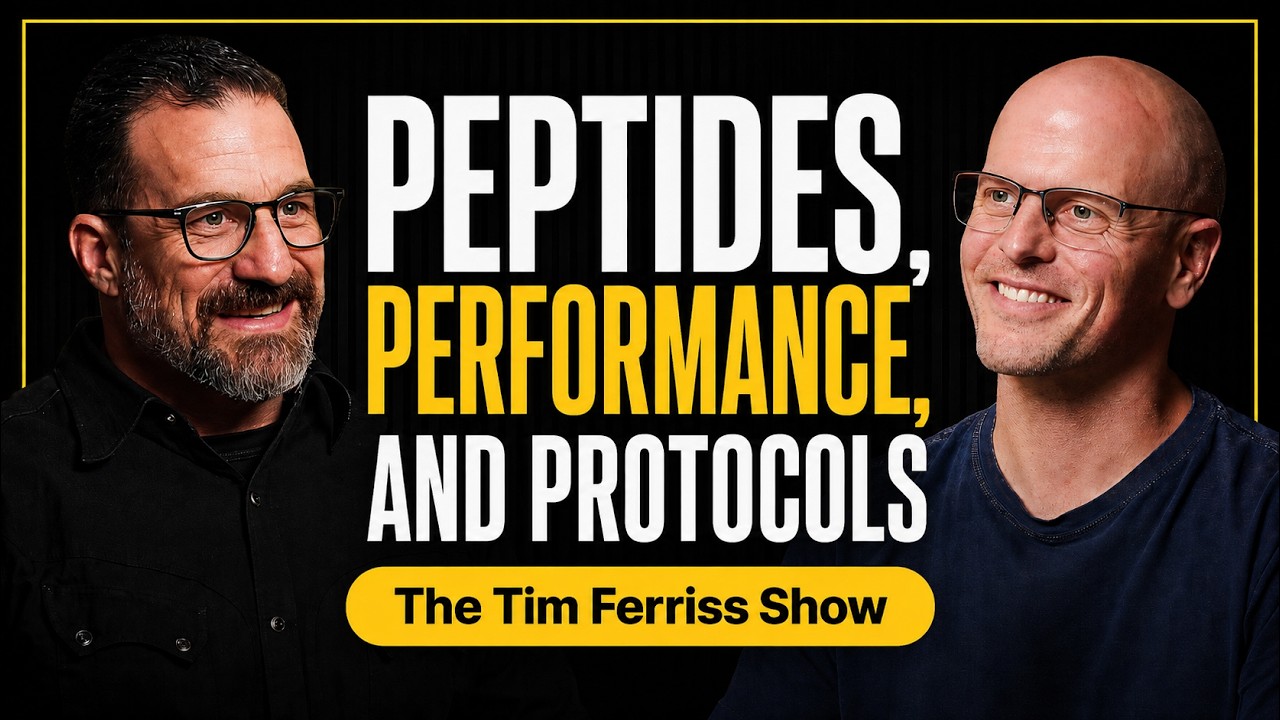 125 min
Dr. Andrew Huberman — Peptides, Performance, and Protocols
 112 min
The Random Show! Mortality, AI, Supplements, Rock Climbing, & More
 88 min
The Legendary Hollywood Power Broker — Guy Oseary on 36 Years of Managing Madonna, 26 IPOs, and More
Ask anything from this episode.
Save it, chat with it, and connect it to Claude or ChatGPT. Get cited answers from the actual content — and build your own knowledge base of every podcast and video you care about.
Get Started Free