Key Moments
⚡️ The best engineers don't write the most code. They delete the most code. — Stay Sassy
 Latent Space Podcast
Key Moments
Advanced AI coding tools are shifting the focus from writing code to deleting it, raising concerns about managing AI budgets per employee and the potential for increased organizational instability due to rapid AI adoption.
Key Insights
The shift from subsidized AI models to consumption-based API pricing in 2026 will necessitate new management strategies for fluid AI budgets at the individual employee level.
The cost of AI tools for engineers could reach $50,000 to $100,000 per year, with some OpenAI employees reportedly spending billions of tokens daily, equating to millions of dollars annually.
The build vs. buy decision for software becomes more complex with AI, as sophisticated mature software, even if seemingly simple, still requires significant effort to develop, maintain, and scale internally.
With AI accelerating code generation, the importance of code review is amplified, as a breakdown in this process could lead to significant system instability, as evidenced by the Amazon outage attributed to a coding error.
AI's impact on the workforce may extend to leadership roles, with potential for AI to automate standardized executive tasks, freeing up human leaders for more complex and unique strategic challenges.
Despite technological advancements, core human management principles like compassion, team well-being, and fostering trust remain critical and are areas where AI may struggle to replicate human interaction.
The escalating costs and management challenges of AI adoption
The landscape of AI tool pricing is rapidly transitioning from subsidized, request-based models to consumption-based API pricing. This shift in 2026 is expected to create significant management challenges, particularly around individual AI budgets. Companies will need to grapple with deciding how much AI budget to allocate to each employee, a task likened to managing variable hardware costs where one employee might utilize $50,000 worth of AI resources annually while another uses far less. This introduces a new dimension to operational budgeting, forcing managers to evaluate the ROI of AI spend on an individual level. The potential for engineers to rack up annual AI bills of $50,000 to $100,000 is becoming a realistic concern, with some industry insiders suggesting these figures could be even higher, potentially reaching millions for heavy users based on current token consumption rates. This necessitates a fundamental rethink of how companies manage resources and allocate budgets in an AI-augmented workforce.
Rethinking the build versus buy paradigm in the age of AI
The long-standing debate between building software in-house versus purchasing external solutions is being reframed by the advent of AI, though the core principles remain relevant. While AI tools can accelerate development, many sophisticated software products possess complexities that are often underestimated by those considering internal development. The effort involved in creating, administering, scaling, and ensuring the uptime of internally built software can be substantial. Leaders often find it more efficient to buy solutions they don't have to manage, maintain, or worry about feature roadmap development for. A useful heuristic suggested is that if a product can be effectively replaced by a robust spreadsheet, it might be a candidate for internal development. However, for more complex systems, the old reasons for buying—such as avoiding the day-to-day operational burdens and the risk of critical failures during demanding periods—still hold significant weight. Organizations must carefully assess the true complexity and long-term maintenance costs before committing to an in-house build.
The amplified criticality of code review in AI-driven development
As AI tools accelerate code generation, the practice of code review becomes not less, but more critical. The recent Amazon outage, reportedly linked to a coding error attributed to internal software, underscores the potential for even sophisticated organizations to face significant disruptions. In an environment where code volume is exploding due to AI assistance, there's a temptation for some to bypass thorough reviews, viewing it as a bottleneck. However, this overlooks the fundamental role of engineers as checks and balances. A robust code review culture acts as a safeguard against errors, whether from new hires or more experienced developers. In a scaled software system, the inability of a single individual, even one with malicious intent, to bring down production systems is a hallmark of a strong culture. AI's ability to rapidly generate code increases the risk if this invariant—that the team is responsible for safety and quality—is broken. Companies need to adapt their cultures to ensure that rigorous review processes remain in place, preventing the 'army of one' mentality and maintaining system stability.
AI's potential to automate leadership and redefine organizational structures
While much of the AI discussion focuses on automating junior-level tasks, there's a compelling argument for AI to augment or even automate aspects of leadership and executive roles. Many management and leadership tasks, particularly those that are repetitive or follow established industry standards, could be handled by AI. This could free up human leaders to focus on more complex, strategic, and 'exotic' challenges that require unique human judgment. Concepts like decision trees and structured workflows, even without full AI, can already automate a significant portion of what managers do. The idea of 'fractional' or AI executives managing standardized aspects of roles could emerge, allowing human leaders to concentrate on the 20% of their work that truly requires nuanced human insight. This shift challenges the traditional approach of layering AI onto the bottom of the organizational chart and instead suggests exploring automation at the top, potentially turning the traditional org chart on its head.
The enduring importance of human judgment and emotional intelligence
Despite the rapid advancements in AI and automation, human judgment, emotional intelligence, and interpersonal skills remain indispensable. While AI can excel at pure automation and even complex decision-making based on data, it currently lacks the nuanced understanding of human emotions, workplace dynamics, and the ability to build trust. For instance, managing a team of humans through 'off days' or fostering intrinsic motivation and psychological safety are areas where AI is far from replicating human managers. The prospect of an AI manager, while perhaps technically feasible, raises questions about how human behavior would change in response, potentially creating a 'Heisen-problem' where the very act of implementation alters the outcome. Furthermore, the value of human connection is profound; many individuals may prefer dealing with human flaws and lower-quality management over a perfectly efficient but emotionally sterile AI. This suggests that while AI will undoubtedly augment many roles, the management of human capital will remain a distinct and critical human endeavor.
The evolution of software development and the future of work
The year 2026 is poised to be a highly dynamic period for the software industry, marked by significant shakeups and a redefinition of what it means to engineer software and run businesses. The increasing power of AI tools means that individuals who are adaptable and embrace these changes are likely to find significant opportunities. However, core challenges will likely revolve around human interaction: ensuring alignment on goals, avoiding isolated development 'bubbles,' and effectively collaborating with others. As old problems are solved by AI, new ones will emerge, driven by human dissatisfaction and the tendency to move goalposts. The increasing documentation of history through digital media offers a valuable perspective, highlighting past technological limitations and the significant improvements in quality of life and efficiency. This perspective suggests that while the journey of AI adoption will involve adjustments and potential pitfalls, the overall trajectory points towards greater efficiency and potential for better decision-making, both in professional and personal spheres. The key will be navigating this evolution by embracing AI while not veering too far from addressing fundamental human problems and interactions.
Mentioned in This Episode
●Software & Apps
●Companies
●Organizations
Common Questions
Companies will need to shift from subsidy-based AI pricing to consumption-based API pricing. Managers will face the challenge of allocating fluid AI budgets individually, considering factors like job criticality, efficiency, and direct value calculation, similar to departmental budgeting.
Topics
Mentioned in this video
Mentioned as a type of software that might be internally buildable, similar to a spreadsheet.
Amazon Web Services, mentioned as a business-critical system that other business-critical systems are built upon, highlighting Amazon's role in infrastructure.
A social news website focusing on computer science and entrepreneurship, which was a key growth engine for the Stay SaaSy blog in its early days.
Mentioned as an example of software that could potentially be built internally, similar to a spreadsheet-based solution.
An issue tracker and project management tool mentioned as the potential cause of an outage at Amazon.
Mentioned as a benchmark for AI impressiveness, noting that people are no longer as impressed by it as when it was first released, highlighting the 'hedonic treadmill' effect.
Mentioned in relation to a recent outage caused by 'vipecoding' attributed to Jira, serving as an example of how even large, critical organizations can be affected by software reliability issues.
A social media platform where Stay SaaSy has a presence, described as a 'turbo charge' for engagement and community building.
Mentioned as a service that could benefit from AI by reducing cognitive load for users.
Included as an example of a service that could be enhanced by AI, making tasks easier and reducing user cognitive effort.
Mentioned for its 'chaos engineering' and 'chaos monkey' practices, used to test system resilience.
A platform used by Stay SaaSy for their blog, noted for its community features and as a place for learning and engaging with content.
Cited as an example of a service where AI could be beneficial by reducing people's willingness to exert cognitive effort.
Mentioned in the context of product pricing and improvements over time, with a comparison between 2016 and 2026 pricing for MacBooks.
An artificial intelligence research laboratory that was mentioned in the context of high token usage by an individual and their team.
More from Latent Space
View all 206 summaries 86 min
Notion’s Sarah Sachs & Simon Last on Custom Agents, Evals, and the Future of Work
 78 min
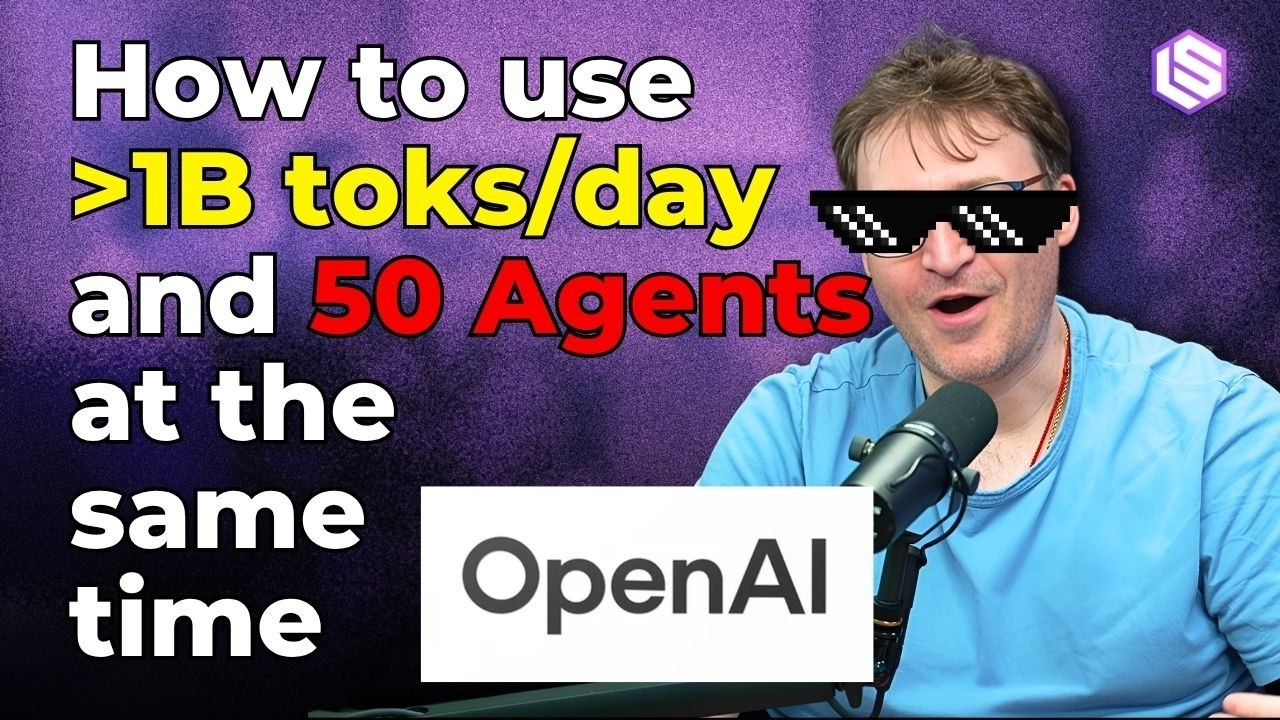
Extreme Harness Engineering for the 1B token/day Dark Factory — Ryan Lopopolo, OpenAI Frontier
 77 min
Marc Andreessen introspects on Death of the Browser, Pi + OpenClaw, and Why "This Time Is Different"
 67 min
Moonlake: Multimodal, Interactive, and Efficient World Models — with Fan-yun Sun and Chris Manning
Found this useful? Build your knowledge library
Get AI-powered summaries of any YouTube video, podcast, or article in seconds. Save them to your personal pods and access them anytime.
Get Started Free